The Tarantula That Lost Its Fire
A new composite image combining data from Chandra, Hubble, Webb and the retired Spitzer telescope has helped astronomers solve a long standing puzzle in the Tarantula Nebula, a star forming region 160,000 light years away. Young, massive stars there should be heating enough gas to emit X-rays, but observations showed far less X-ray emission than predicted.
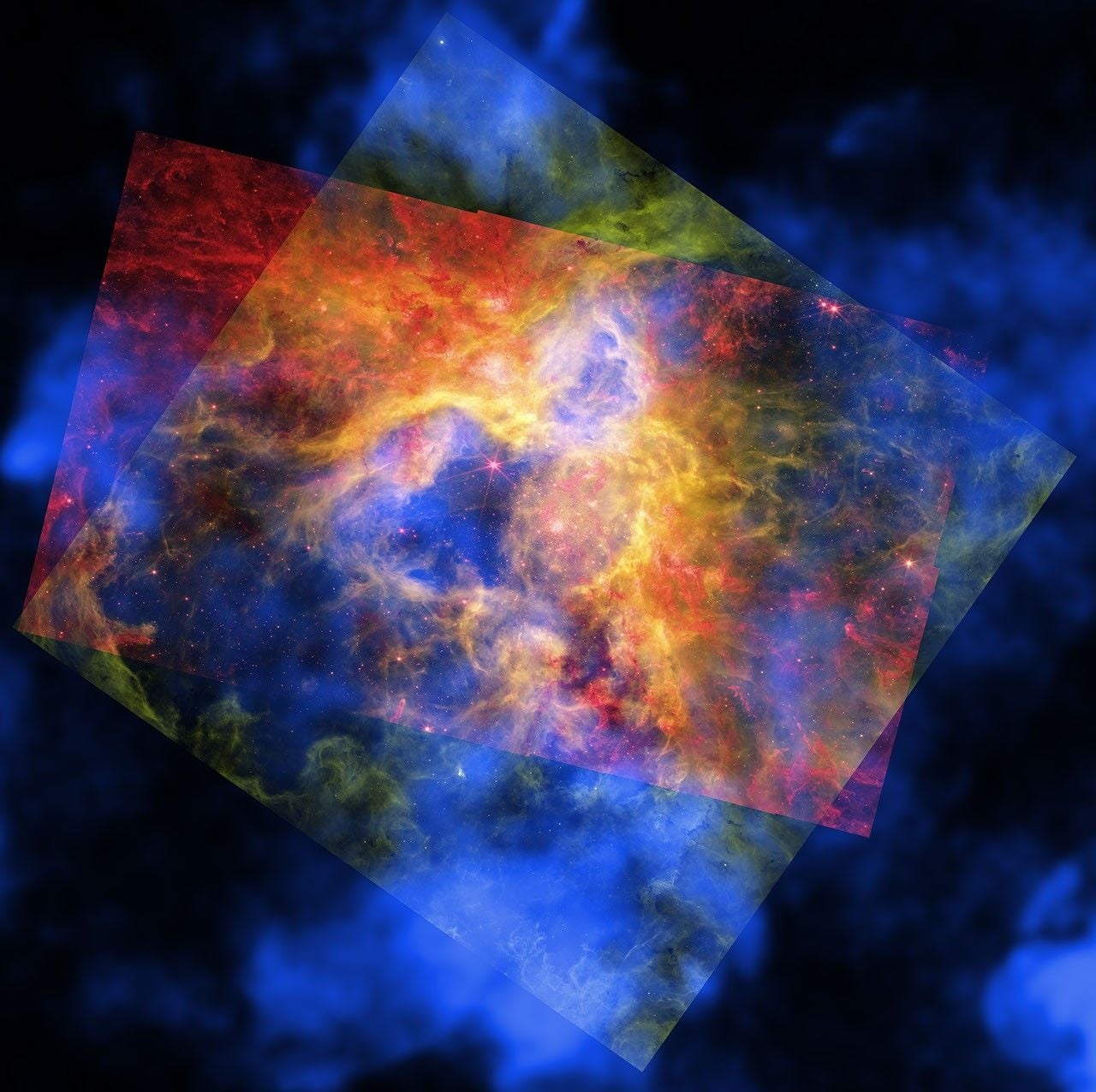
In the distant reaches of the Large Magellanic Cloud, astronomers discovered an unexpected puzzle within the Tarantula Nebula, a stellar nursery also known as 30 Doradus. This region, teeming with young, massive stars, was expected to emit fierce X-ray light due to the intense energy released by stellar winds. Yet, the data collected by NASA's Chandra X-ray Observatory showed far less X-ray-emitting gas than predicted.
To unravel the mystery, a team of researchers led by Jennifer Rodriguez at Ohio State University combined data from four space telescopes: Chandra, Webb, Hubble, and Spitzer. The resulting image presented a striking composite, with Chandra's X-rays in blue, Webb's infrared in red, Hubble's optical view in green, and Spitzer's archival data adding to the visual narrative.
The team concluded that the Tarantula Nebula was losing its energy through three separate escape routes, including leakage through the surrounding gas and dust structures, cooling by turbulent mixing with colder gas, and conduction through direct contact between hot and cooler gas. While none of these processes alone fully explained the shortfall, together they accounted for the missing energy.
This discovery highlights the ongoing mysteries in even the most studied celestial bodies and the importance of combining data from various telescopes to solve complex problems.
Written by urgent.news from Universe Today's reporting — not their text. Machine-written — may contain errors; check the original before relying on it.