Ask Ethan: Why are astronauts weightless while still in Earth’s gravity?
If you stand here on the surface of the Earth, whether at the north pole where the acceleration is greatest or at the summit of Huascarán where it’s the smallest, you’ll be pulled towards the center of the Earth with an acceleration of 9.8 m/s² : the acceleration due to gravity, or “ 1 g ” on the surface of the Earth. Sure, there are tiny variations that will ensue, as your distance from Earth’s…
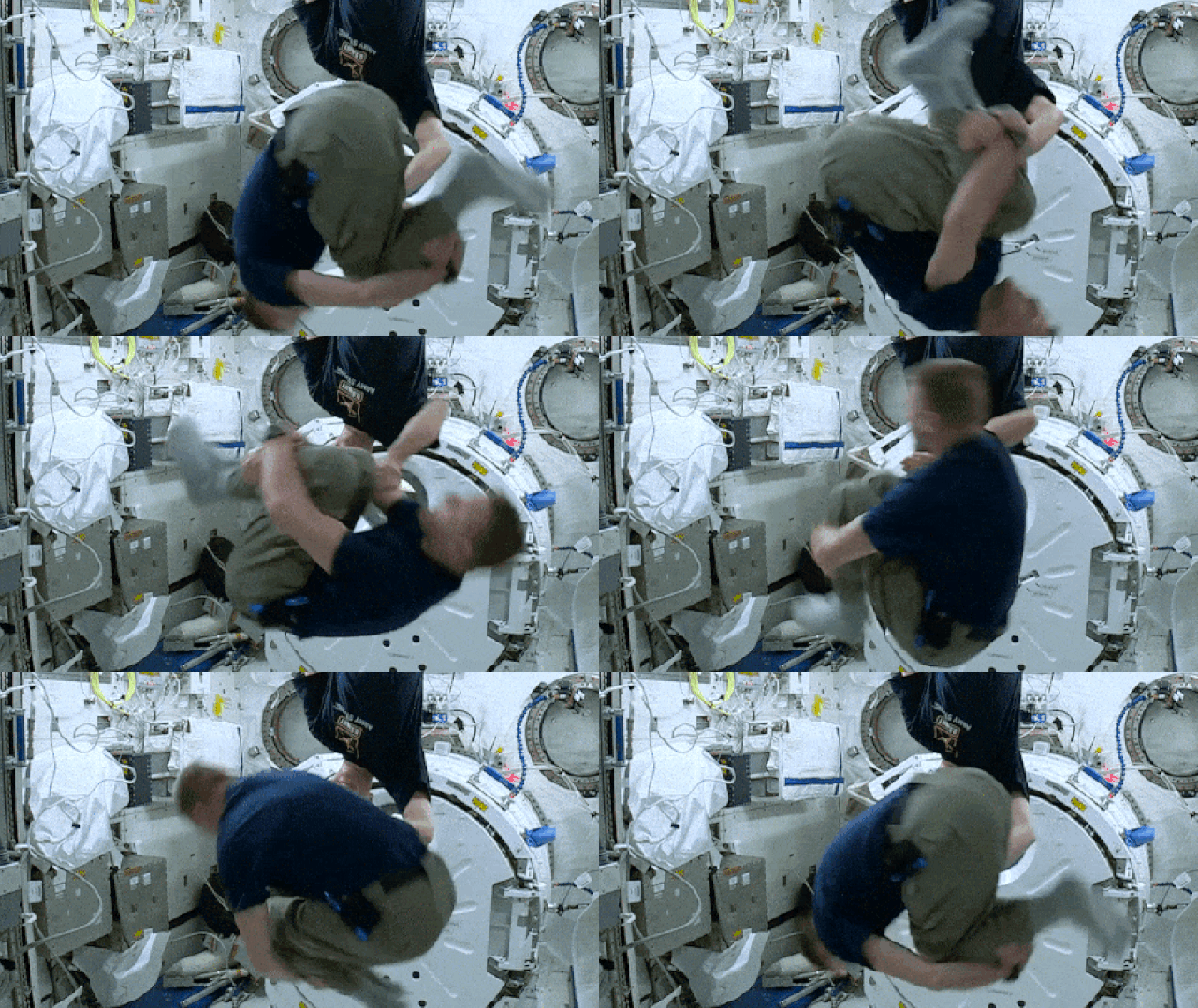
On Earth's surface, individuals experience an acceleration of 9.8 m/s² due to gravity, which is often referred to as "1 g." This force causes objects to feel weight, which can be calculated by multiplying an object's mass by the acceleration due to gravity. However, astronauts in space, particularly those orbiting around the Earth, experience a completely different phenomenon: they are weightless while still being under the influence of Earth's gravity. The reason for this dissonance lies in the difference between acceleration and weight.
When an astronaut is in orbit, they are constantly falling towards the Earth due to gravity, but they also move forward at a speed that keeps them in orbit around the planet. This creates a continuous state of free-fall, causing the sensation of weightlessness. The astronaut's mass remains the same, but the acceleration relative to the Earth's surface is zero, as there is no solid surface pushing them upwards to create a normal force.
In simpler terms, there is no opposing force balancing the gravitational force, leading to the sensation of weightlessness.
Written by urgent.news from Big Think's reporting — not their text. Machine-written — may contain errors; check the original before relying on it.