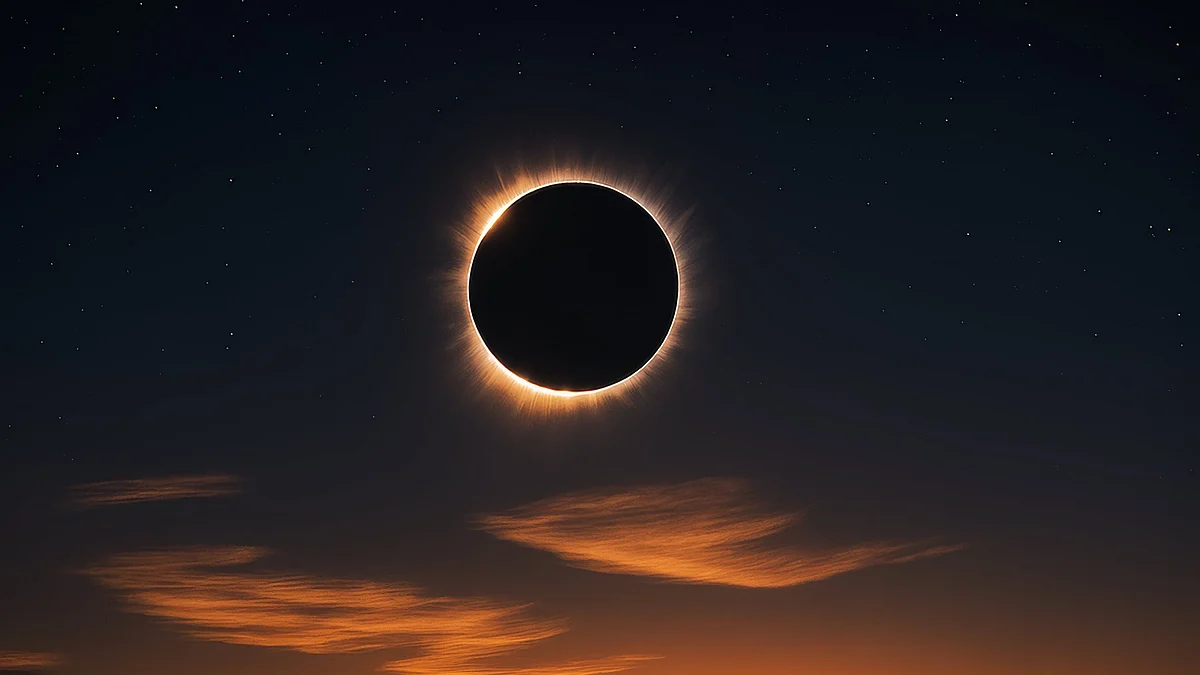
For the eclipse on 12.8.: In the moon's shadow: How researchers use the solar eclipse
The solar eclipse is not just an impressive natural phenomenon - it also enables scientific insights. The space agencies Esa and Nasa want to take advantage of this.
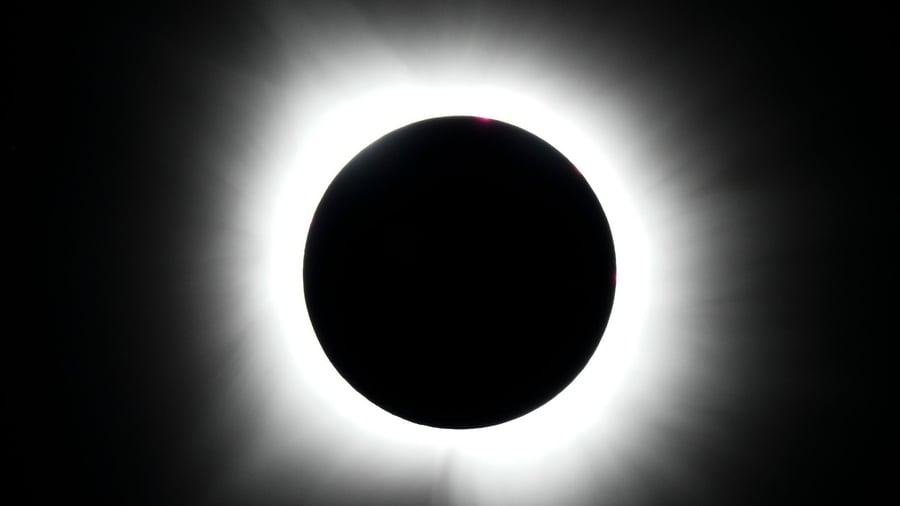
On August 12th, when the Moon slides in front of the Sun, it's not just a stunning celestial show. Despite constant observation of our central star by space probes, a solar eclipse still offers scientists unique opportunities to study the Sun. Specialized aircraft and balloons equipped with a variety of instruments ascend through the narrow zone of total darkness stretching from Greenland across Iceland to Spain.
Observatories like the "Solar Orbiter" and "Soho" (Solar and Heliospheric Observatory) use a protective filter to darken the bright solar disk, revealing the Sun's outer atmosphere, the hot corona. "During such events, we can test special techniques," explains solar researcher Daniel Müller from the European Space Agency Esa. However, due to safety reasons, the filter must be larger than the solar disk to prevent some of the bright sunlight from bending and scattering on sensitive sensors and damaging them.
"Soho" only observes the corona from about half a solar radius away from the surface. During a total solar eclipse, this issue does not occur, and researchers can see the corona down to the Sun's surface. Another advantage, explains solar expert Daniel Müller: "During such events, we can test special experiments and techniques that would not be feasible to pack into a satellite on a whim."
For these, the start costs for space flights are too high. Only when the methods are sufficiently tested and proven on Earth are they successfully implemented in space. Together with the US space agency NASA, Esa plans combined observations from Earth and space. A NASA special aircraft follows the Moon's shadow moving at 2,500 kilometers per hour across the Earth's surface.
On board the plane is a camera that captures 20 high-resolution images of the corona per second. The additional angle provided by observing the Sun from a different perspective allows for the creation of stereoscopic, three-dimensional images of structures in the solar corona. The corona consists of thinly distributed gases that reach millions of degrees, while the surface of the Sun is only around 6,000 degrees.
What causes this gas to heat up in the corona remains largely unexplained. Observations of the researchers during the solar eclipse could provide further clues to solving the mystery.
Written by urgent.news from Handelsblatt's reporting — not their text. Machine-written — may contain errors; check the original before relying on it.