Shapers of the Future: This company turned 43 brands into one
The Körber corporate group sold off 70 percent of its sales - and then tripled it. How did CEO Stephan Seifert manage the restructuring that many competitors shy away from?
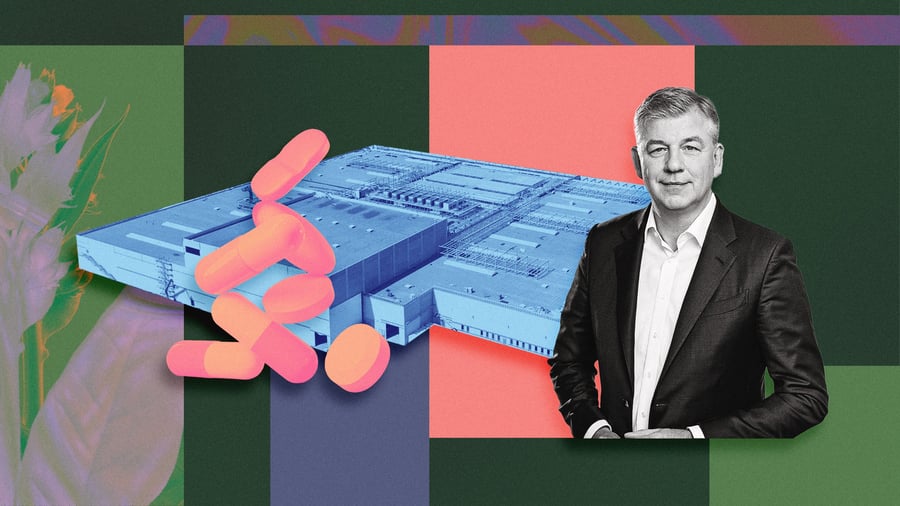
Behind Stephan Seifert's desk hangs a large photo collage. John F. Kennedy is seen on a sailing ship. "You can choose whether he's coming out of the storm or sailing into it," says Seifert. He is the CEO of Körber. For the group, however, it applies: "We sail close to the wind."
In one of the storms of the past, the traditional foundation-based group had decided to change course radically. During the financial crisis, more than 50 percent of Körber's businesses were affected by profit declines or stagnation, says Seifert. That was the moment when they decided to focus fully on mega and technology trends.
What followed was a radical transformation: the group separated from 70 percent of its sales at the time - and said goodbye to businesses with revenues of 1.6 billion euros. Only to grow by a multiple afterwards.
How this can succeed and what other companies can learn from Körber's transformation is shown by a look into the interior of the technology group, which is celebrating its 80th anniversary this year.
With the help of institutes in China, the USA, and Germany, Körber identified attractive future fields. Accordingly, Körber acquired a series of companies. Last year, the group achieved a record turnover of more than three billion euros. By 2035, it should be ten billion.
1. Farewell to profitable businesses
An important aspect of portfolio transformation: the businesses that Körber divested were not in need of restructuring. Most corporations fail to change, says Seifert, because they cling to the old for too long: "The most difficult thing is not to dare something new, but to detach from what one has grown fond of."
Körber started the restructuring when everything was still running smoothly. The businesses that were later divested had partly double-digit returns. Körber was a mechanical engineering company with leading technologies, says Seifert. However, areas such as machine tool construction and paper were not growth markets and were threatened by new competitors from China, among others.
Some businesses lacked critical size, while others were not ready for digital business models. Paper and hygiene papers were on a path of stagnation, while at the same time, technological barriers to entry for competitors were decreasing, says Seifert. "The cost spiral is always a threat there."
2. How Körber built up new business areas: Pharma as a blueprint
Körber's pharma division is far from that. It illustrates well how the group proceeds in its three divisions, which also include Technologies (tobacco) and Supply Chain. The Markt Schwaben site, where pharmaceutical inspection machines are built, is bursting at the seams.
A mobile lightweight hall serves as a temporary storage facility on the factory premises, as it has become so tight. Körber is currently consolidating three locations at a new site in order to further increase capacities.
In recent years, the division has already experienced significant growth, says Managing Director Ralph Hugeneck. The corona vaccinations and the boom in weight loss injections had additionally driven the business temporarily.
But even independently of this, demand is growing. "Our customers are currently building new factories all over the world."
Pharma is one of the growth fields that Körber had identified as attractive during the reorientation. "Pharma is a long-term growth market," says Kevin Hillmann, who serves as Head of Business Development and Digitization in the Pharma business area.
People are getting older, and more and more people have access to medicine and healthcare. According to IQVIA forecasts, the global pharmaceutical market, for example, is expected to grow by 5 to 8 percent annually in the coming years.
Körber already had smaller pharmaceutical activities in its portfolio when the acquisition of the traditional company Seidenader in 2011 laid the foundation for the inspection segment - i.e., the control of production for contamination and other errors.
Today, Körber is clearly ahead in the inspection market for pharmaceutical products with around 30 percent globally, and only a few providers can meet the high regulatory requirements.
"A large part of the corona vaccines has run through our inspection machines," says Hugeneck, "without Körber, the vaccines would not have been available on the market so quickly."
The inspection technology must reliably detect every contamination, explains Hillmann. However, it is also important that the rejection rate of actually correct batches is not too high.
For example, harmless air bubbles on the sensor can act like a foreign particle. Here, AI also helps to further reduce the so-called "false eject rate".
The secret of Körber's pharma division's success? "We are anchored deeper in the value chain than many of our competitors," says Hillmann.
The group now covers almost every step after production - from quality control to enabling tracking to packaging machines.
Körber took a similar approach to building up the second new pillar, called Supply Chain. This includes, for example, autonomous transport robots, warehouse and automation systems, and software for the logistics sector.
One of the largest acquisitions was the purchase of Siemens' postal and parcel sorting systems.
3. The traditional tobacco business was allowed to stay - and is being expanded
At a large construction site in the Bergedorf innovation park, Körber's past and future meet. For more than 200 million euros, the group is building a new company location for the core division Technologies.
The production of two locations is being consolidated here and...
Translated by urgent.news. Machine-written — may contain errors; check the original before relying on it.