Economic crisis: "The Kennedy of Bolivia" - why Latin America's elites are seeking advice from this TikToker
Sayuri Loza is one of the most influential indigenous voices in Bolivia. A meeting with her in El Alto, where the influencer is celebrated like a pop star.
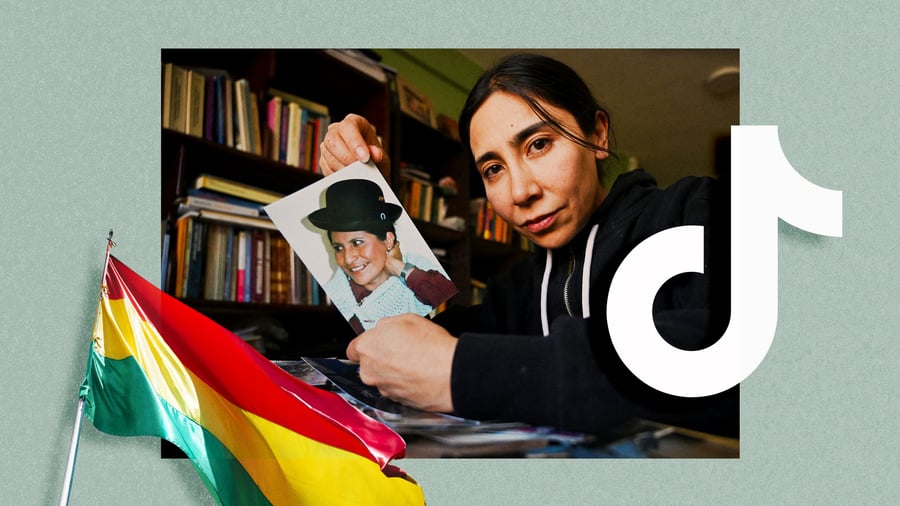
If you meet Sayuri Loza at one of the cable car stations in El Alto, you might think she's a student. A petite, young woman with a serious look and long braids. Against the strong sun at 4,000 meters, she wears a wide-brimmed felt hat, against the cold, a blue down jacket. But if you walk with her through one of the bustling street markets in Bolivia's second-largest city, it's like accompanying a pop star.
Young women ask for selfies, giggling. Female vendors and cooks wave at her. Again and again, older women in the pollera, the wide, pleated skirt of the Aymara indigenous people, with embroidered shawls and traditional melon hats, approach her. They speak to her in their Aymara language, some visibly moved, others with great respect.
They know Sayuri Loza from social media, where she appears only with her first name, which has become her stage name. With around 75,000 followers on the video platform Tiktok, the 42-year-old is one of Bolivia's most widely followed political and cultural commentators. This is because she combines aspects of the country that typically cause division.
Indigenous young people follow her, as do journalists, politicians, and entrepreneurs. And so, the influencer plays a crucial role in overcoming the political and social crisis that Bolivia is facing. Sayuri is an identification figure for the indigenous people, having grown up in her mother's Aymara culture. In her short videos, she talks about Bolivian politics and the country's economic situation.
She showcases indigenous avant-garde fashion, discusses with influential artists, explains the real estate market in El Alto, or talks about fast food in an airport restaurant in New York. But she also posts videos about everyday observations, event tips, or her dog. The language is mostly Spanish. By profession, Sayuri works as an interpreter for Japanese and Aymara, writes children's books in her native language, and is a real estate agent, hat maker, and entrepreneur with her own market stalls.
This makes her an identification figure for indigenous listeners. "We celebrate indigenous symbols," she says. "But our own language is dying." Many parents have deliberately let their children learn only Spanish, as they hoped for better opportunities. Because of role models like Sayuri, young indigenous women are learning Aymara again.
Indigenous people make up more than half of Bolivia's total population of around 13 million people. The Aymara and Quechua are the country's largest ethnic groups, with 34 other groups officially recognized. Bolivia has the highest proportion of indigenous population in South America. Her liberal-conservative basic attitude makes her an interesting advisor for politicians and entrepreneurs.
Many other politically active indigenous people are more from the left-socialist spectrum. Sayuri, on the other hand, refers to the entrepreneurship of Aymara culture. All of El Alto looks like a huge bazaar, pure capitalism. "We turn every opportunity into a business and distribute the risk," she says proudly. A year ago, Samuel Doria Medina came to El Alto, then a presidential candidate for a center-right coalition.
Medina has become one of Bolivia's wealthiest entrepreneurs with a cement company; he owns American fast-food chains in the country and has built the country's highest office tower in the capital La Paz. During his visit to El Alto, he was leading in the polls, considered the favorite, mainly due to his economic competence. But Sayuri warned him: "This country loves symbols.
You can't convince people with economic numbers alone." She turned out to be right. Medina ended up in a distant third place and didn't even make it to the runoff. Instead, conservative candidate Rodrigo Paz won. Even though entrepreneurs in El Alto had voted for left-wing President Morales for years, they were deeply conservative, Sayuri explained afterwards.
The Kennedy of her country Sayuri's influence is also explained by another part of her background. She comes from a political dynasty. "I'm like a Kennedy in the US here in Bolivia," she says without vanity. Her mother Remedios was a well-known radio and TV presenter nationwide. In 1989, she became the first indigenous woman in traditional clothing to enter the National Congress, and eight years later, she ran for the presidency.
Sayuri's father Carlos Palenque - of Spanish descent - was one of the country's most famous media entrepreneurs and politicians, but he never officially recognized her as his daughter. Sayuri's mother ensured that she could attend the prestigious Jesuit school San Calixto in La Paz. Sayuri says she was always an outsider between two worlds.
"The Aymara see me as a white person," she says. "The white people think I'm a cholita." Once used as a discriminatory term, indigenous women now use "Chola" or "Cholita" with cultural pride. Ethnic superiority is also the wrong path. Sayuri enters the Waliki restaurant in El Alto. It belongs to a friend. She goes into the smoke-filled kitchen.
Chicken soups are cooking in large cauldrons. Meat skewers are being grilled, and waiters are urged to hurry. The operator's mother rules loudly. When she sees Loza, her features relax. Suddenly, there is silence. The women talk to each other in Aymara, and the joy of the visit is obvious. Sayuri says: "When I speak Aymara, people drop their protective wall."
Precisely because Sayuri is both insider and outsider, her analysis of Bolivian politics is so clear. Between 2006 and 2019, Evo Morales ruled as president.
Translated by urgent.news. Machine-written — may contain errors; check the original before relying on it.