Shanghai's Houtan Park turns polluted land into a natural water purifier
Shanghai’s Houtan Park showcases the remarkable transformation of a contaminated industrial site into a thriving wetland that effectively purifies river water daily. The design cleverly integrates recycled materials, honoring local heritage while addressing waste reduction. Its ecological contributions include carbon sequestration and supporting wildlife recovery, setting a benchmark for urban…
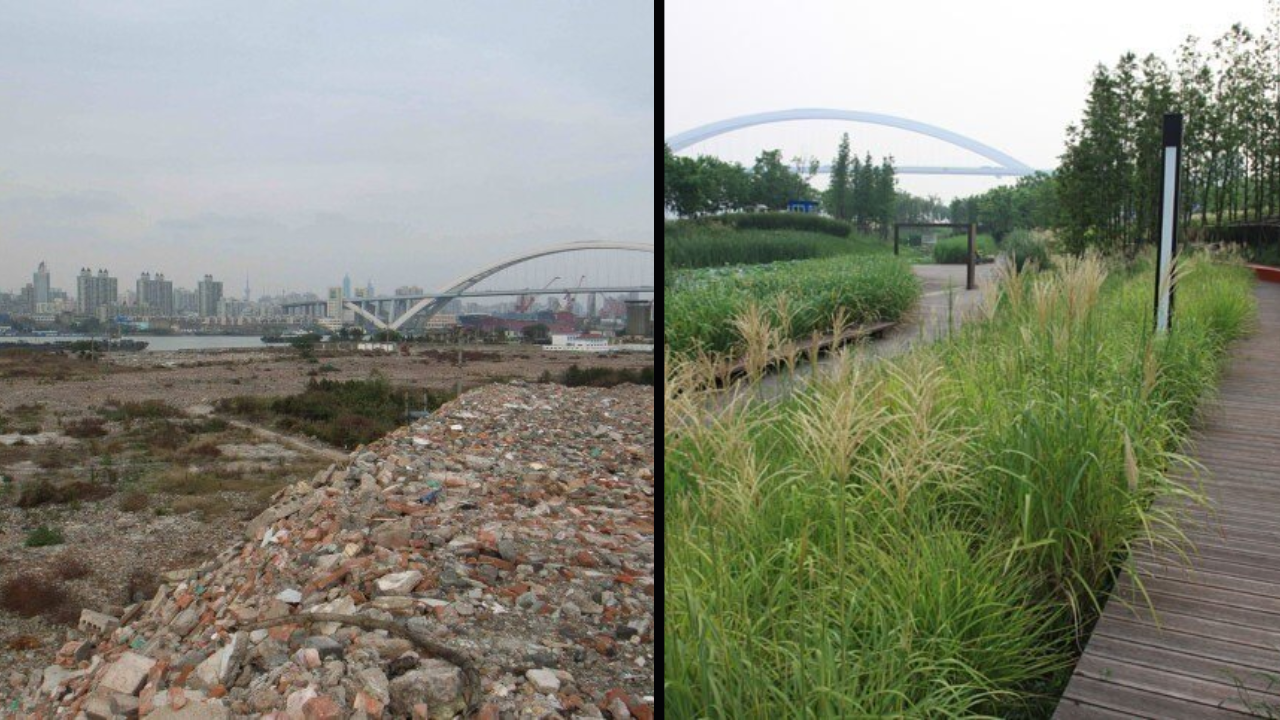
In 2010, Shanghai converted a polluted industrial land into a natural water purifier known as Houtan Park. The 14-hectare linear park, stretching along the Huangpu River, replaced a site that once housed a steel factory, a shipyard, and a heavy industrial storage facility. The area had been used as an industrial waste dumping ground for decades, with security walls separating it from the city. Pollution would flow through the area unchecked.
Through the efforts of landscape architect Dr. Kongjian Yu and his firm Turenscape, the site underwent a complete transformation. Instead of relying on energy-hungry chemical treatment plants or traditional concrete pipes, the team developed a living biological filter. This multi-stage wetland takes raw, highly polluted Grade V river water and purifies it to Grade II quality, making it suitable for landscape irrigation and water features.
The wetland's design consists of a continuous, mile-long artificial system that runs through the park's center. Water is pumped to the highest point of the site and then flows through terraced drops, oxygenating cascades, sand beds, and dense reed beds. These elements help trap suspended solids and absorb heavy metals, nitrogen, and phosphorus from the water.
Special aquatic plants and microorganisms in the plants' root zones further clean the water. Oxygen is naturally added as the water flows over stone steps and terraced landforms inspired by traditional Chinese agricultural landscapes.
The biofiltration system provides significant economic benefits. It supplies 264,000 gallons of treated water daily to adjacent Expo Park's ponds, fountains, and streams, avoiding the need for costly municipal tap water. The project has also received eight national design patents in China and has inspired similar ecological water purification projects across the country.
The park's transformation brought about immediate ecological benefits, with the dense wetland ecosystem capturing approximately 242 tons of carbon annually. A post-occupancy performance study reported 93 plant species and over 200 animal species within the park, acting as an ecological corridor along the riverfront. The construction process adhered to low-carbon principles, with workers recovering 37 tons of structural steel and 34,000 post-industrial bricks to reuse in pedestrian paths, shade structures, seating, and park pavilions.
Houtan Park also contributes to urban flood protection. The site replaced an existing concrete floodwall with a terraced embankment planted with native wetland species. During high tides or storm surges, the lower terraces can flood naturally without damaging park facilities or nearby buildings. The park's flood protection system, combined with its water filtration capacity, industrial heritage preservation, and public recreational space, serves as a model for converting polluted industrial sites into useful public spaces in dense cities.
Written by urgent.news from Times of India's reporting — not their text. Machine-written — may contain errors; check the original before relying on it.