The Real Cryptography Behind a Fictional Quantum Machine
A novel about a machine that breaks RSA-4096. Seven details readers assume were invented for the plot, traced to the document each actually came from.
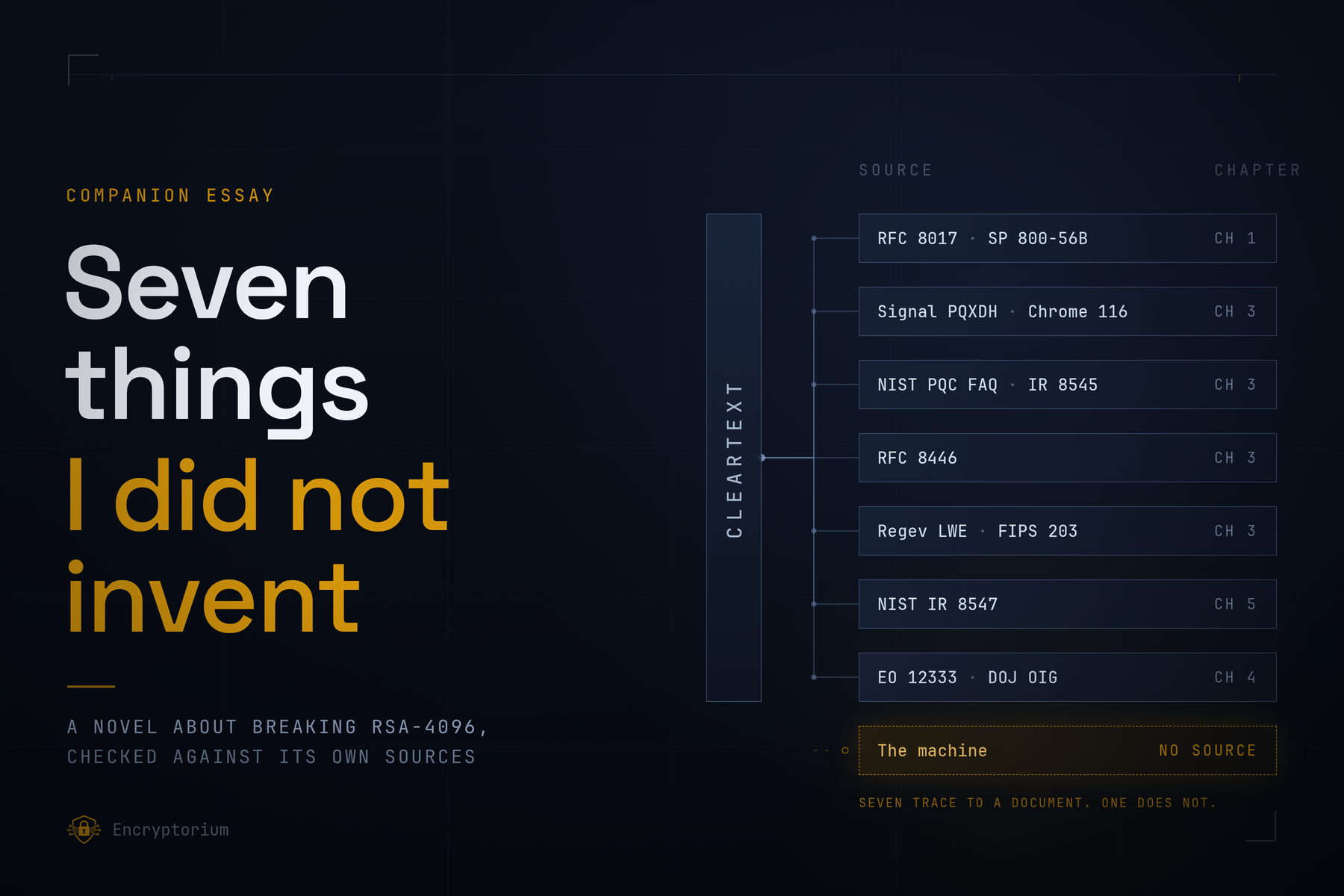
The story, set in an imaginary realm, revolves around a fictional quantum machine whose cryptography is largely based on existing algorithms rather than being invented from scratch. The narrative details seven aspects considered fictional, each rooted in a specific source.
Firstly, the API specifies ciphertext as "RSA-4096 with OAEP padding" in the first chapter, while a later check reveals the public exponent as 65537, a standard choice. OAEP, or Optimal Asymmetric Encryption Padding, is an enhancement to RSA encryption, introduced in 1994 by Bellare and Rogaway to improve security, as documented in RFC 8017 [1]. The choice of 65537, a Fermat number, stems from NIST SP 800–56B Revision 2, which specifies it as the minimum value for an odd public exponent [4].
Secondly, the novel claims that Signal and Chrome integrated Kyber, a post-quantum key encapsulation mechanism, before its formal standardization. This is accurate, as Signal announced PQXDH, a protocol using both X25519 and Kyber, in September 2023 [7], and Google introduced Kyber for Chrome in August 2023 [8]. Both companies surpassed the standardization timeline, making it happen before the tale's opening act.
Thirdly, the protagonist sketches a whiteboard in the novel, dividing it into two columns: what the API breaks and what it refuses. The former includes AES-256, AES-128, SLH-DSA, Classic McEliece, and the latter contains AES-256, AES-128, SLH-DSA, and Classic McEliece. This is consistent with quantum cryptanalysis, though not a direct result of it.
Shor's algorithm is efficient against factoring and discrete logarithms, but not symmetric ciphers, which are protected against attacks like Grover's algorithm. Grover's algorithm halves the strength of a symmetric cipher, leaving AES-128 relatively secure [12][14][15]. However, SLH-DSA, a hash-based signature scheme, remains unaffected by quantum attacks and thus is placed on the right side of the whiteboard, despite being impractically large in size.
Lastly, the narrative clarifies that protection lies in the algorithm, not the message itself. The whiteboard's omission highlights this, as seen when the protagonist deciphers a PGP-encrypted communication using 4096-bit RSA keys and AES-256, which the API successfully breaks in under two seconds [16][17]. Thus, the story avoids speculative elements, presenting a factual account of the cryptography depicted in the source.
Written by urgent.news from HackerNoon's reporting — not their text. Machine-written — may contain errors; check the original before relying on it.