E‑Mobility: Why the electric truck boom is stalling at the power connection
The prices for electric trucks are falling, their range is increasing - many haulage companies are now switching. The problem: The charging infrastructure can't keep up.
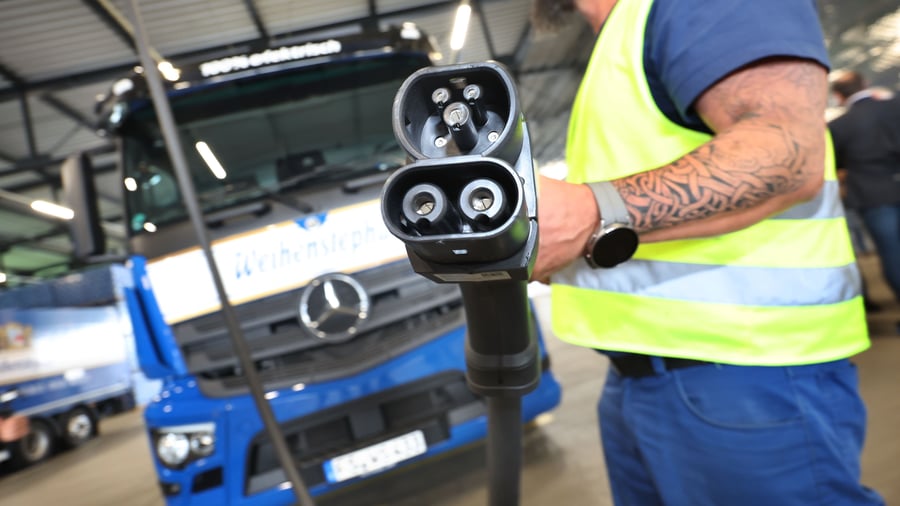
If you want to take a look at the future of logistics, you should head to East Frisia. On this July morning, 32 red tractor-trailers are parked in the yard of the Nanno Janssen logistics company in Leer. Visually, the 40-tonners are no different from diesel trucks. "But they're all purely electric," says junior boss Nanno Edzard Janssen, pointing to a thick, black charging cable on one of the trucks.
Inside the office, his father, Nanno Janssen senior, sits attentively in front of a wall of flat screens. "I'm monitoring the stock exchange electricity price here," he says. "It's been quite expensive all morning." Too little wind is one reason, and the other is "the French." In the neighboring country, many nuclear power plants have been throttled back due to drought and heat.
Now, the senior boss wants to wait until some trucks are loaded - "until the photovoltaic systems start humming at noon and hopefully drive prices down."
Four years ago, the Janssens began converting their fleet of around 90 large tractor-trailers to battery power. Not like other logistics companies with one or two electric trucks for testing, but with 20 at once. Meanwhile, 60 Janssen trucks are driving electrically, and the rest will soon follow; seven new electric tractor-trailers will be added this month.
The Ostfriesen still belong to the electro-avant-garde in logistics; less than one percent of trucks in Germany have been electric so far. However, the market is gaining momentum. Seven percent of newly registered heavy-duty trucks (over twelve tons) are electric here, and in 2025, new registrations grew by 38 percent compared to the previous year, and in the first half of 2026, by 41 percent.
The sale of diesel trucks, on the other hand, shrank by 6.3 percent. Elsewhere, the transformation is happening even faster: in Scandinavia or the Netherlands, every fifth new truck is already running on batteries, and in China, even every second one.
However, with the boom, a new problem arises: 51 percent of logistics companies are concerned about the charging infrastructure for their electric trucks, according to a recent survey by the Öko-Institut. The rapid market growth seems to be overwhelming the operators of fast-charging stations on the highways.
Although there are now 53,300 public fast-charging points in Germany - for electric cars - only 218, distributed across 88 locations, are quickly and easily usable for 40-tonners, i.e., without having to unsaddle the trailer.
And those who, like the Janssens, want to charge mainly in their own depot, have to wait up to ten years for the necessary grid connection. However, the boom in battery trucks is only just beginning.
In clean-room talks, in which truck manufacturers regularly give politicians insight into their plans, Daimler Truck, MAN, Scania, and Renault/Volvo expect an average market share of battery trucks of 50 percent of new registrations in Europe from 2030 onwards.
According to a survey by the Öko-Institut among 240 German logistics companies, 61 percent are seriously considering buying battery trucks; in 2021, it was 5 percent. For a long time, heavy long-distance trucks and battery propulsion did not go together.
Electric trucks were outrageously expensive, and their range was severely limited. "But a lot has changed technically, especially in the past two years," says Nanno Janssen junior. At the end of 2024, there were 45 models of heavy electric trucks; today, there are around 100, more than double that.
Their range has tripled from 200 to 600 kilometers on average. The Janssens are already using their electric trucks like diesel trucks: in long-distance transport, for heavy loads, but "also for project work, where drivers often don't know where they'll be sleeping on Wednesday," says Janssen junior.
Another plus: "The purchase prices of electric tractor-trailers are falling," says Patrick Plötz, who researches the electrification of transport at the Fraunhofer-Institut ISI. Two years ago, a battery truck cost three times as much as a diesel, currently around twice as much.
And it's likely that "Chinese manufacturers will push into the European market and drive prices down further." For many logistics companies, an electric truck now also makes sense relatively: because heavy trucks drive an average of 100,000 kilometers per year, eight times as much as cars, the operating costs weigh more heavily - and "with high diesel prices, the total cost calculation in many logistics companies tips more quickly towards battery propulsion," says Plötz.
This also applies to the Janssens in Leer. "Previously, a battery truck had paid off its higher purchase price after six years," i.e., towards the end of its economic life, "economically a zero-sum game," says Janssen senior.
Today, with good purchase prices, high diesel costs, and electricity purchases at the depot, a battery truck pays off for the Janssens quickly: "The truck drives into the profit zone for us after three years."
Especially since electric trucks are exempt from the truck toll until at least 2031 - "a major cost block on long-distance routes," according to Janssen. "Those who charge mainly in their own depot can often reduce their driving electricity costs to a fraction of the diesel fuel costs per kilometer," confirms Fraunhofer researcher Plötz.
While public charging electricity for trucks on the go is similar in price to that for cars (at least 30 cents per kilowatt-hour, often 50 or more), logistics companies and carriers benefit from cheaper commercial electricity prices at their home depot, depending on the quantity and region, 18 to 26 cents.
Markus Lienkamp, Professor of Vehicle Construction and Electrification at the Technical University of Munich, evaluated GPS data from 150 heavy trucks with 2.15 million kilometers driven in two projects with truck manufacturers and logistics companies.
What route lengths do the trucks drive? How much electricity do they need for this? How often do they manage to get back to the depot with one battery charge? How often are they dependent on on-the-go charging?
The surprising result: 85 percent of the energy demand of electric trucks can be covered by their own depot.
Translated by urgent.news. Machine-written — may contain errors; check the original before relying on it.