Competing Molecular Interactions Govern the Dynamical Arrest of G3BP1 Condensates
G3BP1 is a central scaffold of stress granules (SGs). Upon cellular stress, G3BP1 forms complex coacervates with translationally repressed mRNAs and recruits multiple RNA-binding proteins to form reversible biomolecular condensates. Persistent SGs are linked to age-dependent dynamical arrest and impaired disassembly. Here, we employ active and passive nanoscale rheology with optical tweezers to…
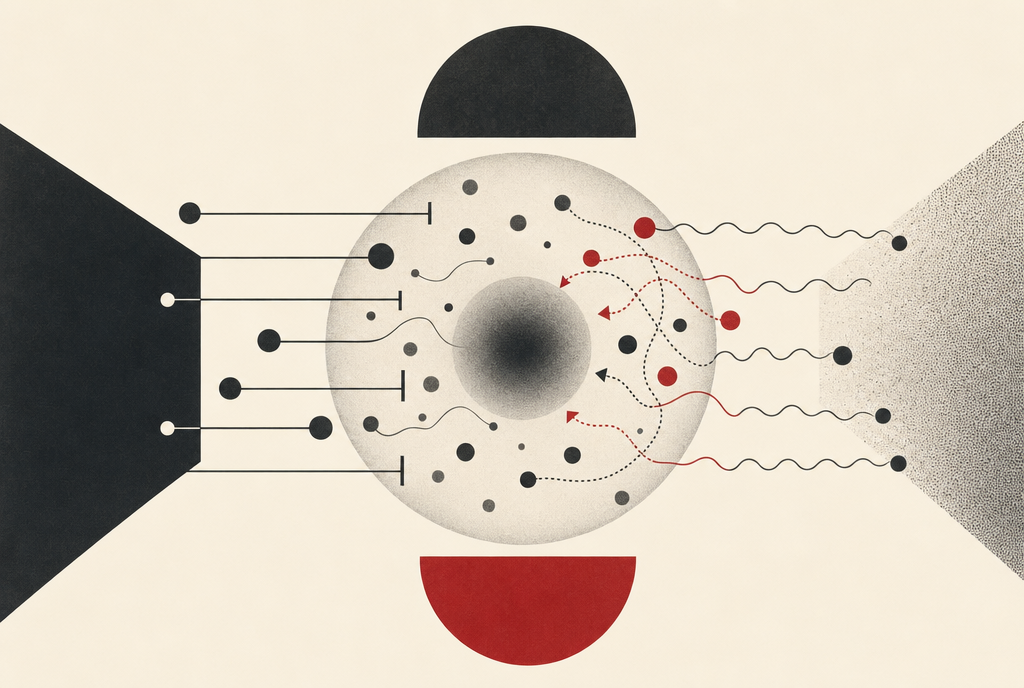
The research paper titled "Competing Molecular Interactions Govern the Dynamical Arrest of G3BP1 Condensates" delves into the intricate world of stress granules (SGs) and their dynamic arrest. G3BP1, a crucial scaffold of SGs, forms complexes with translationally repressed mRNAs and recruits various RNA-binding proteins to create reversible biomolecular condensates. However, SGs can persist, leading to age-dependent dynamics and impaired disassembly, which is a significant concern in aging cells.
To understand this phenomenon better, the study employs a combination of active and passive nanoscale rheology using optical tweezers. This technique allows researchers to observe the transformation of G3BP1 condensates from being predominantly viscous fluids to dynamically arrested network glasses. These glasses exhibit nanoscale caging and elastic memory, indicating a more complex state than initially thought.
The study further integrates atomistic and coarse-grained simulations with experimental data to gain a comprehensive understanding. It is found that electrostatic interactions between the intrinsically disordered regions (IDRs) of G3BP1 drive the condensate ageing process. These interactions are modulated by RNA in a length- and structure-dependent manner, delaying dynamic arrest. However, binding of Caprin-1 to the NTF2L domain of G3BP1 has little effect on this process.
In conclusion, this research provides a new perspective on how competing inter-IDR and IDR-RNA interactions govern condensate ageing and transitions between different material states. The findings have broader implications for understanding and regulating SG dynamics in cells, particularly in the context of aging.
Written by urgent.news from bioRxiv's reporting — not their text. Machine-written — may contain errors; check the original before relying on it.