The Endangered Species Act Reduces Housing
Max Tabarrok’s paper on the Endangered Species Act and housing (WP) has just been published in the Journal of Public Economics! It’s a clever paper: Max observed that the moment an animal is put on the endangered species list, developers face enhanced compliance costs and liability risk. But what’s important for an empirical economist is […] The post The Endangered Species Act Reduces Housing…
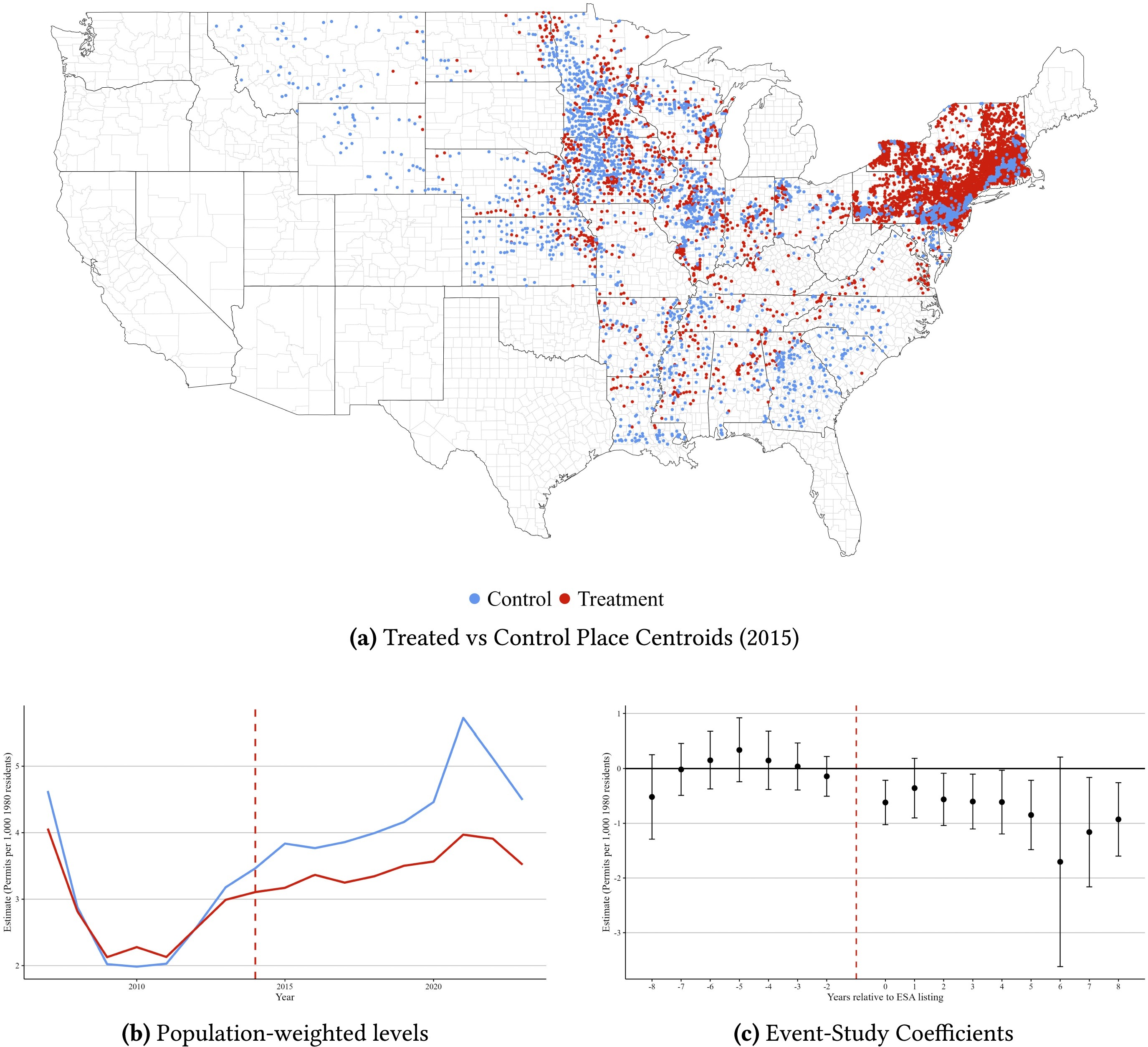
Max Tabarrok's recent paper in the Journal of Public Economics reveals a potential link between the Endangered Species Act (ESA) and reduced housing development. The study found that an additional endangered species listing can reduce annual housing permit flows by 0.5 permits per thousand residents, roughly equivalent to a 10% decrease in permit flow for the average location.
Accounting for spillovers, the overall impact of the ESA on the national housing stock is estimated to be around 6.3 million missing units between 1980 and 2024, or about 4% of the 2025 housing stock.
The ESA's restrictions primarily affect areas where species habitat exists, rather than existing housing developments. This impact is found at both the extensive and intensive margins of housing production. At the extensive margin, the tradeoff between species protection and housing production may be positive-sum, as it encourages less dense greenfield development.
At the intensive margin, the tradeoff is less binding, as new developments often replace existing structures or fill in space within highly developed areas where endangered species cannot thrive even without additional construction.
Further analysis using satellite data from the National Land Cover Database (NLCD) and heterogeneity within the Building Permits Survey shows that the most urbanized 15% of places account for 90% of total permit flows, while the highest-value endangered species habitat is located outside of these developed areas. The ESA seems to impose restrictions on infill development in already-dense areas as much as it does on greenfield development in more rural, exurban sprawl.
Relaxing the ESA's restrictions on infill development in these developed areas could potentially increase housing supply while preserving some endangered species habitat.
This paper may be particularly timely, as the Trump administration is considering ways to limit the ESA's reach. The findings suggest a possible compromise that could satisfy both housing proponents and environmentalists: easing the ESA's impact on infill and redevelopment in already-built-up areas, rather than applying it uniformly across all regions.
Written by urgent.news from Marginal Revolution's reporting — not their text. Machine-written — may contain errors; check the original before relying on it.