Mars' Double Storm Problem
A new study presented at the Royal Astronomical Society's National Astronomy Meeting suggests that solar storms may warm the Martian lower atmosphere, but only when they strike during a major Martian dust storm. The discovery was accidental, emerging from a search for a different effect entirely, and hints that the weather system on Mars may be more tangled and interconnected than scientists…
Scientists studying Mars' space weather discovered a surprising connection between solar storms and Martian weather by accident. The team from Lancaster University, the University of Leicester, and Spain's Instituto de Astrofisica de Andalucia aimed to investigate whether high-energy solar particles could heat Mars' lower atmosphere, where weather occurs. This is crucial as Mars has a thin atmosphere and lacks a strong global magnetic field to shield it from the Sun's energy.
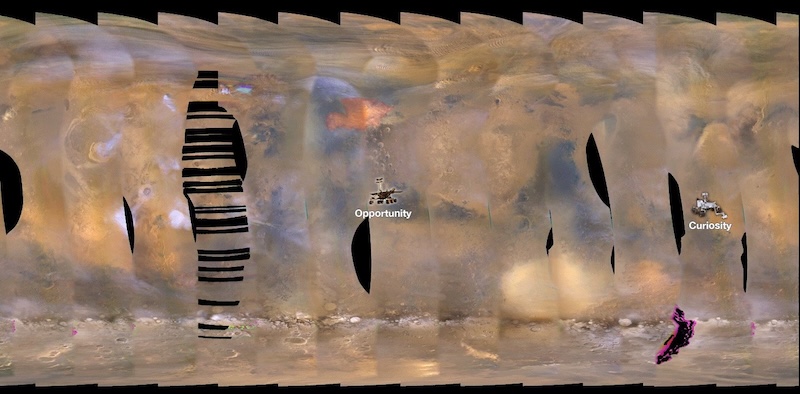
They examined five solar particle events, and while four showed no heating signal, the fifth, from June 2018, did. This coincided with a massive global dust storm that crippled NASA's solar-powered Opportunity rover. During the overlapping event, the researchers detected genuine heating in Mars' lower atmosphere, which didn't align with dust storm heating alone. The dust storms do generate heat by absorbing sunlight, but the heating pattern observed didn't fit that explanation.
The researchers are cautious about their findings, noting that a single overlapping event isn't definitive proof. However, the discovery raises an intriguing possibility – that Mars' atmosphere might respond to combined solar and dust storm events in ways that studying them separately would miss. The team only noticed the dust storm connection when the heating appeared in one event out of five, prompting further investigation.
If future observations confirm this pattern, it could mean that Martian weather models need to account for the Sun and dust working together, rather than independently.
Written by urgent.news from Universe Today's reporting — not their text. Machine-written — may contain errors; check the original before relying on it.