Accelerator Report: Beyond the LHC – CERN’s Beams Keep Science Moving
The Large Hadron Collider (LHC) may have entered Long Shutdown 3 (LS3), but across the rest of CERN’s accelerator complex operations remain as busy as ever. The LHC injector chain continues to provide proton beams for a broad range of users, including the ELENA antiproton community, the East and North Area experiments and the n_TOF […]
While the Large Hadron Collider (LHC) enters its Long Shutdown 3 (LS3), CERN’s accelerator complex remains actively operational, providing proton beams to various experiments and supporting future research developments. The LHC injector chain continues to supply beams for a wide range of users, such as the ELENA antiproton community, East and North Area experiments, and the n_TOF facility.
These operations demonstrate the extensive scientific potential of CERN’s accelerator complex, even as the LHC is prepared for its next phase.
Alongside the standard operation of the LHC injectors, the High Radiation to Materials facility (HiRadMat) concludes its annual beam year. This facility tests materials and equipment using intense beam pulses from the Super Proton Synchrotron (SPS), simulating the extreme conditions that accelerator components may face during operation.
This year, HiRadMat includes a crucial experiment determining the failure thresholds and behavior of various materials under intense beam exposure, providing valuable information for the reliability and robustness of beam monitoring in high-intensity accelerators.
The machine development (MD) programme at CERN also remains busy, fine-tuning existing processes and exploring new beams and operational methods. A recent focus has been the future SPS Beam Dump Facility (BDF), designed for the Search for Hidden Particles (SHiP) experiment, which aims to detect feebly interacting, long-lived particles that could help explain fundamental questions about the universe, such as dark matter and the matter-antimatter asymmetry.
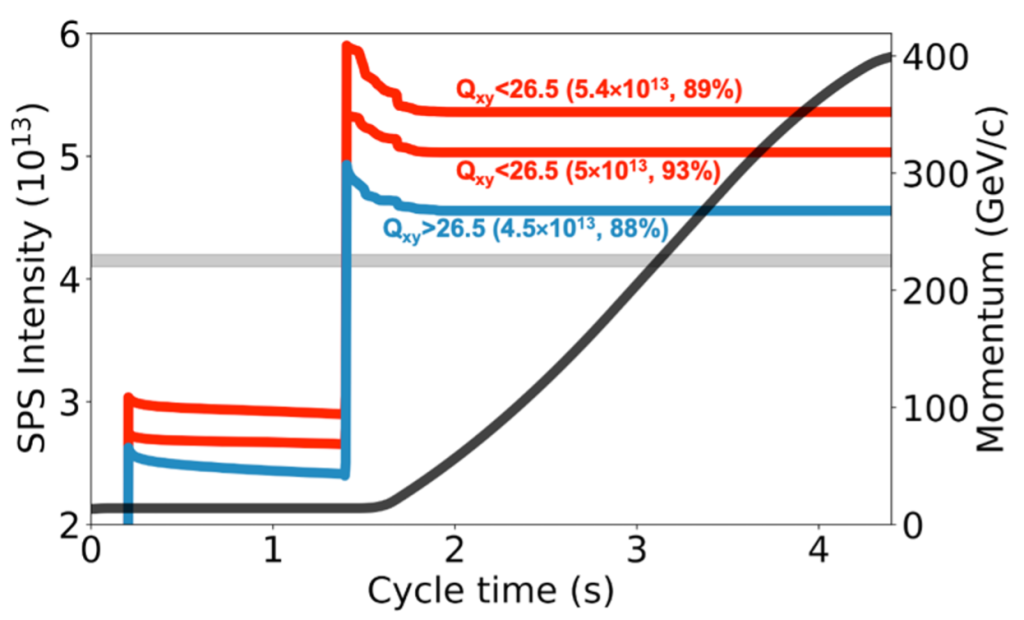
Recent tests demonstrated successful cooling of a tungsten target while exposed to a 400 GeV/c proton beam, and the SHiP cycle intensity was increased to a record 5.4 x 10^13 protons per cycle at 400 GeV/c.
As the North Area gears up for its ion-physics programme, the SPS will begin producing lead beams for experiments in the coming weeks. This move will open a new chapter in CERN’s accelerator schedule, further expanding the research capabilities of the complex. CERN continues to push the boundaries of scientific discovery, ensuring that its accelerator complex remains at the forefront of accelerator technology and research.
Written by urgent.news from CERN's reporting — not their text. Machine-written — may contain errors; check the original before relying on it.