The ELT's Spectrograph Could Sniff Out Biosignatures on Other Worlds
Before any major telescope commissioning, there are dozens of papers that attempt to define what we can expect from it. We’re starting to see some come through for the Extremely Large Telescope (ELT), which hopefully will get a more imaginative name when the 39m behemoth is officially commissioned in Chile in the 2030s. A new paper from Evann Kurzawa-Ferrandez and his co-authors at NASA’s Jet…
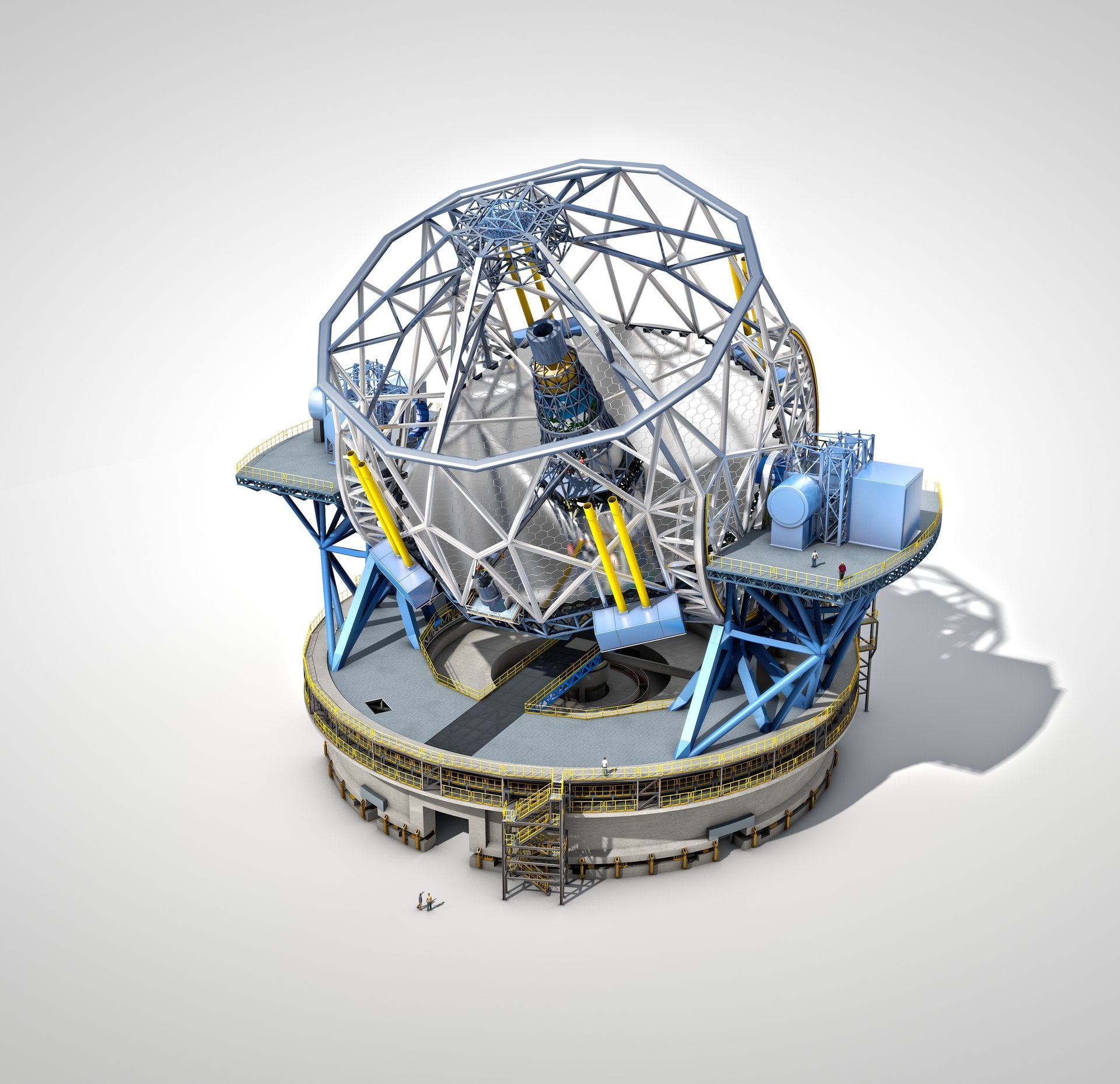
The Extremely Large Telescope (ELT) is set to revolutionize the search for biosignatures on distant exoplanets. A new paper from NASA's Jet Propulsion Laboratory outlines the types of gases the ELT could potentially detect on some of our closest exoplanets. These gases include carbon dioxide, water vapor, methane, and oxygen, each with a unique spectral signature.
The ELT will utilize the ArmazoNes high Dispersion Echelle Spectrograph (ANDES) to capture the light from these planets as they transit in front of their stars. ANDES is one of the main instruments on the ELT and will be responsible for detecting the gases in the atmosphere of these planets. The researchers selected 18 potentially habitable rocky planets that pass in front of their host stars, including several from the TRAPPIST-1 system, which is known for its interesting candidates for potential biosignatures.
The researchers noted that detecting water is relatively easy, requiring between 10 and 19 transits. However, detecting oxygen is the most challenging, requiring roughly four times as many transits. While the ELT is expected to be highly efficient in detecting biosignatures, the researchers also acknowledged the limitations and assumptions made in their simulations, such as the absence of clouds or hazes and the absence of stellar flares or sunspots.
Nonetheless, this paper provides a realistic and mathematically sound forecast of the ELT's capabilities to detect biosignatures on exoplanets.
Written by urgent.news from Universe Today's reporting — not their text. Machine-written — may contain errors; check the original before relying on it.