Quantum Physics Could Help Us Find Earth 2.0
When astronomers talk about directly imaging an exoplanet that is orbiting a far away star, the analogy they most commonly go with is trying to spot a fireflight next to a massive search light. An Earth-like exoplanet is incredibly dim - usually between 100 million and 10 billion times fainter than its host star. Understandably, that makes them very difficult to see. But a new paper from Hyunsoo…
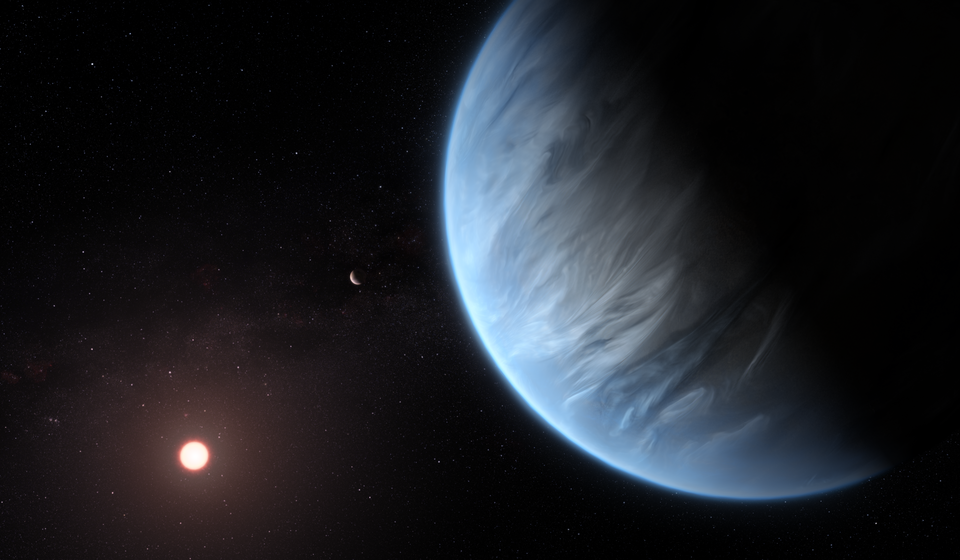
In a groundbreaking study, Hyunsoo Choi and his colleagues from Hanyang University in South Korea propose a novel approach to detect Earth-like exoplanets using quantum physics. These planets are notoriously dim, emitting light up to 10 billion times fainter than their host stars, making them extremely difficult to observe. The key to their method lies in the concept of the Rayleigh limit, a threshold at which two nearby objects' light waves merge into a single blob, rendering normal photodetectors ineffective in distinguishing between the planet and its star.
To overcome this hurdle, the researchers introduced a quantum measurement technique called spatial-mode measurement. Unlike traditional photodetectors, which only detect photon energy, this approach also considers a photon's wave shape, providing additional information that regular cameras overlook. To implement this in real-time, the team built a continuous feedback loop into their image analysis software.
They employed a logarithmic scale to track extreme brightness differences between the planet and star, and a statistical tool called the Bayesian Information Criterion to replace human-generated guesses about the number of planets.
In simulations, the algorithm successfully identified the total number of objects (3) 72.5% of the time, correctly locating the planets within a single pixel and estimating their brightness within a factor of two 99.7% of the time. Although the study relied on computer simulations, it marks a significant advancement in developing quantum imaging systems capable of detecting exoplanets up to 100 million times dimmer than their star.
While challenges remain in translating these findings into practical hardware, the theoretical potential of this approach is undeniable, offering a fresh perspective on exoplanet detection in modern astronomy.
Written by urgent.news from Universe Today's reporting — not their text. Machine-written — may contain errors; check the original before relying on it.