Cortical territories compete in developmental space race
Sensory and association regions are established through a reciprocal process, according to a new model of cortical development.
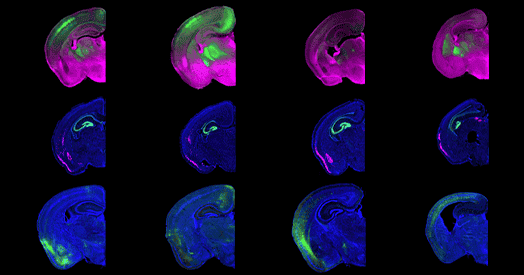
A new study has shed light on the competitive dynamics of cortical development in multiple species, challenging the traditional notion that the association cortex emerges after sensory areas. The research, published in Nature, reveals two distinct sets of genetic instructions that govern the formation of cortical territories in a "multinodal induction-exclusion in network development" (MIND) model.
In this model, the frontotemporal poles of the developing cortex activate a program that guides the formation of association cortex, responsible for higher-order cognition, while simultaneously suppressing sensory input from the thalamus. This suppression leads to the emergence of sensorimotor cortex islands. Over time, the association areas and sensory regions become segregated, resulting in distinct cortical territories.
The study, led by Nenad Sestan at Yale University, found that this competitive developmental process is not unique to primates but is present in other species such as mice, macaques, and even opossums. Interestingly, opossums, which lack a primary motor cortex, have the association cortex in its place. This suggests that the competition between sensory and association cortical regions has deep evolutionary roots.
The researchers also discovered a potential molecular mechanism underlying this competition. Axon-guidance proteins SEMA7A and PLXNC1, enriched in the sensorimotor and association cortex respectively, demonstrate complementary expression patterns and repel each other when cultured together. This finding indicates that the basis of this organization evolved before primates emerged.
Furthermore, autism-linked genes were found to be enriched in both developmental programs, suggesting that altered regulation of these pathways could shift the balance between sensory and association cortical areas during development. This mechanism could potentially explain the altered organization of these regions observed in autistic individuals in neuroimaging studies.
The study provides a new framework for understanding cortical hierarchy and opens up new avenues for comparative evolutionary neuroscience. By examining cross-species approaches, researchers may gain valuable insights into the development of the human brain.
Written by urgent.news from The Transmitter's reporting — not their text. Machine-written — may contain errors; check the original before relying on it.