Exploding Microscopic Black Holes Warmed Young Universe
Understanding the origin and evolution of black holes is quite endeavor, including how they form, behave, what they’re made of, what happens when they collide, and even what happens if you fall into one. But now imagine trying to understand black holes of the early universe, known as primordial black holes, and how they behaved almost immediately after the Big Bang. How did they contribute to the…
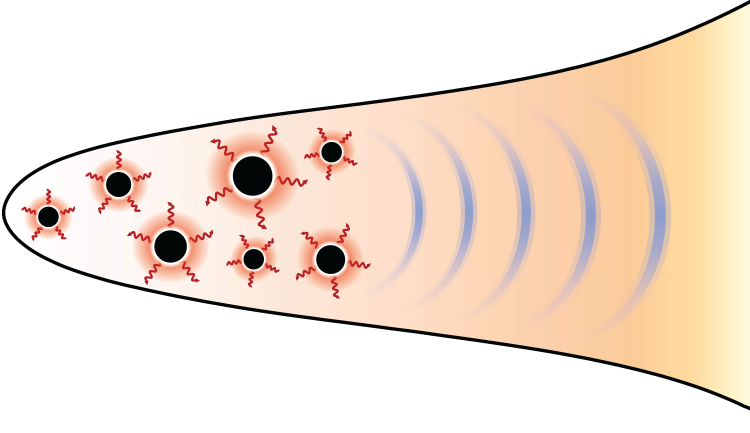
Researchers from Germany's PRISMA++ Cluster of Excellence and Mainz Institute for Theoretical Physics may have uncovered a key piece to understanding the early universe. Their study, published in Physical Review Letters, suggests that microscopic black holes were responsible for reheating the young universe immediately after the Big Bang.
The concept of primordial black holes—formed in the moments following the Big Bang—has long puzzled scientists, as their role in the universe's evolution remains a mystery. Initially, it was believed that all primordial black holes were of the same size, producing uniform gravitational waves at the end of their short lives. However, this study challenges that notion by considering primordial black holes of various sizes.
By incorporating these different sizes into computer simulations, researchers found that larger black holes, while still adhering to a weight limit of 109 grams established by Stephen Hawking, effectively suppressed gravitational waves. This suppression allowed atoms to form without interference from the explosions of these black holes, thereby preventing the universe from expanding too quickly.
The findings highlight the importance of black holes in the early universe, demonstrating how even the smallest of these cosmic entities could have played a pivotal role in shaping the cosmos we see today. As the researchers note, the smallest primordial black holes may have been smaller than an atom, yet their explosive energy could have filled the entire cosmos with plasma, providing the heat necessary for the formation of matter.
This breakthrough not only advances our understanding of the early universe but also sets the stage for future research into the origins of life beyond Earth.
Rewritten by urgent.news; may contain errors — check the original.
Source: universetoday.com