How to Modernize Bank Without Taking Its Payment Systems Offline
A field guide to modernizing legacy banking integration: strangler patterns, anti-corruption layers and security controls that keep payments running.
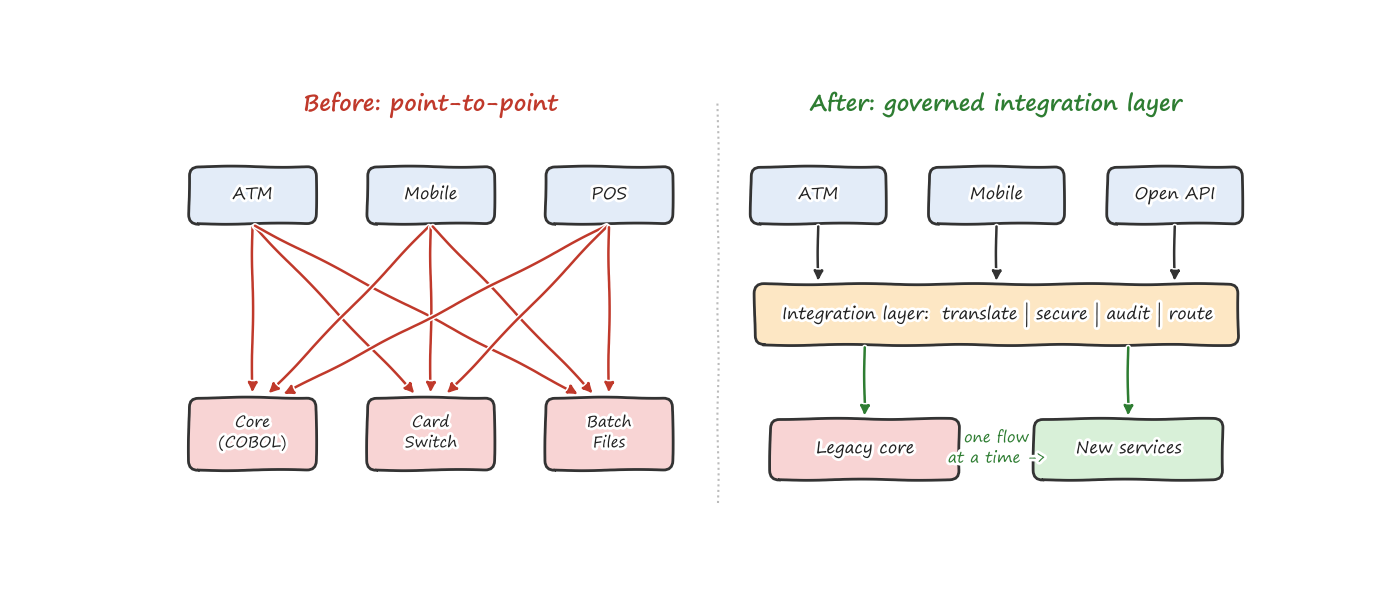
Modernizing a bank's core systems without disrupting payment services is a complex challenge faced by financial institutions worldwide. The temptation is to replace the entire core in one go, but this approach often leads to delays, outages, and account lockouts due to undocumented business rules that only surface when the new system fails. Instead, a more prudent approach is incremental modernization, which is less exciting but far more survivable.
The first step in this process is to meticulously map every integration between systems. This involves cataloging the various protocols, message volumes, peak times, and ownership of each interface. In most cases, this mapping reveals a tangled "spaghetti" of point-to-point connections. For instance, the ATM switch directly communicates with the core, while the mobile app communicates with a SOAP service that ultimately writes to a shared database.
Every additional channel added another direct connection, emphasizing the importance of understanding the existing integration landscape before making any changes.
The second crucial step is to introduce a governed integration layer between the channels and back-end systems. This layer can take the form of an API gateway combined with payment middleware or a message broker, depending on the specific flow. The integration layer serves four primary purposes: protocol translation, anti-corruption, central security controls, and routing.
It translates protocols such as ISO 8583, SWIFT MT/MX, ISO 20022, flat files, SOAP, and proprietary TCP into formats compatible with the legacy core. It also ensures that legacy data models with cryptic codes and fixed-width fields remain hidden from new services, which interact with clean domain objects instead. Additionally, the layer provides central security controls, including authentication, message validation, rate limiting, encryption, and audit logging, addressing vulnerabilities that arise when sensitive data is decrypted for translation and then passed onward in clear.
Once the integration layer is in place, the strangler fig pattern can be employed to migrate one business flow at a time from the legacy system to the new one while the rest of the system remains untouched. This pattern typically starts with read-only flows, such as balance inquiries and transaction histories, which are low risk and high volume, proving the performance of the new system.
Next, low-value write flows like beneficiary management and card limits are migrated. Lastly, payment flows are tackled, starting with a single channel or a single BIN range. Each flow is initially run in shadow mode, where the new path and the legacy system process the same traffic simultaneously, and results are compared. Only when mismatches are near-zero is the routing switch switched over to the new system. Crucially, the routing switch remains reversible for weeks, not hours, ensuring a safe transition.
Security is a common pitfall in integration layers, often overlooked during translation. Patterns such as decrypt-and-forget, where PIN blocks or card data are decrypted for translation and then logged or passed onward in clear, are prevalent. This practice should be avoided as sensitive data should be translated inside a Hardware Security Module (HSM) or tokenized, handled in application memory for the shortest possible duration.
An additional security consideration is the assumption of trust in internal networks. Legacy links often lack authentication because they are "inside the data center." However, when the same link is exposed through an API, this assumption becomes a vulnerability, necessitating the application of mutual Transport Layer Security (TLS) and message authentication on every hop.
During the migration process, it is essential not to lose sight of security and reconciliation. Mismatches between the legacy and new ledgers can indicate migration bugs or hidden business rules that were previously unknown. Therefore, automation of reconciliation is vital, with daily checks at a minimum and near real-time reconciliation for payment flows. Any discrepancies must be thoroughly investigated before they become apparent to customers.
Lastly, it is crucial to plan for the exit, not just the entry. Celebrating the completion of the migration and forgetting to decommission the old path can lead to an increased attack surface and higher costs. For each migrated flow, define the date the legacy path is switched off, who confirms no traffic is still reaching it, how long data is retained for audit purposes, and the ultimate decommissioning plan.
This approach ensures that the migration is completed smoothly, with minimal disruption and maximum security, ultimately benefiting the bank's customers by ensuring that they never notice the migration has taken place.
Rewritten by urgent.news; may contain errors — check the original.
Source: hackernoon.com