Black holes can split apart 'like pants' if they spin too fast, study hints
Astrophysicists have dared to ask a cosmological question never asked before: Do black holes "wear pants"? New research shows how fast-spinning black holes may split apart.
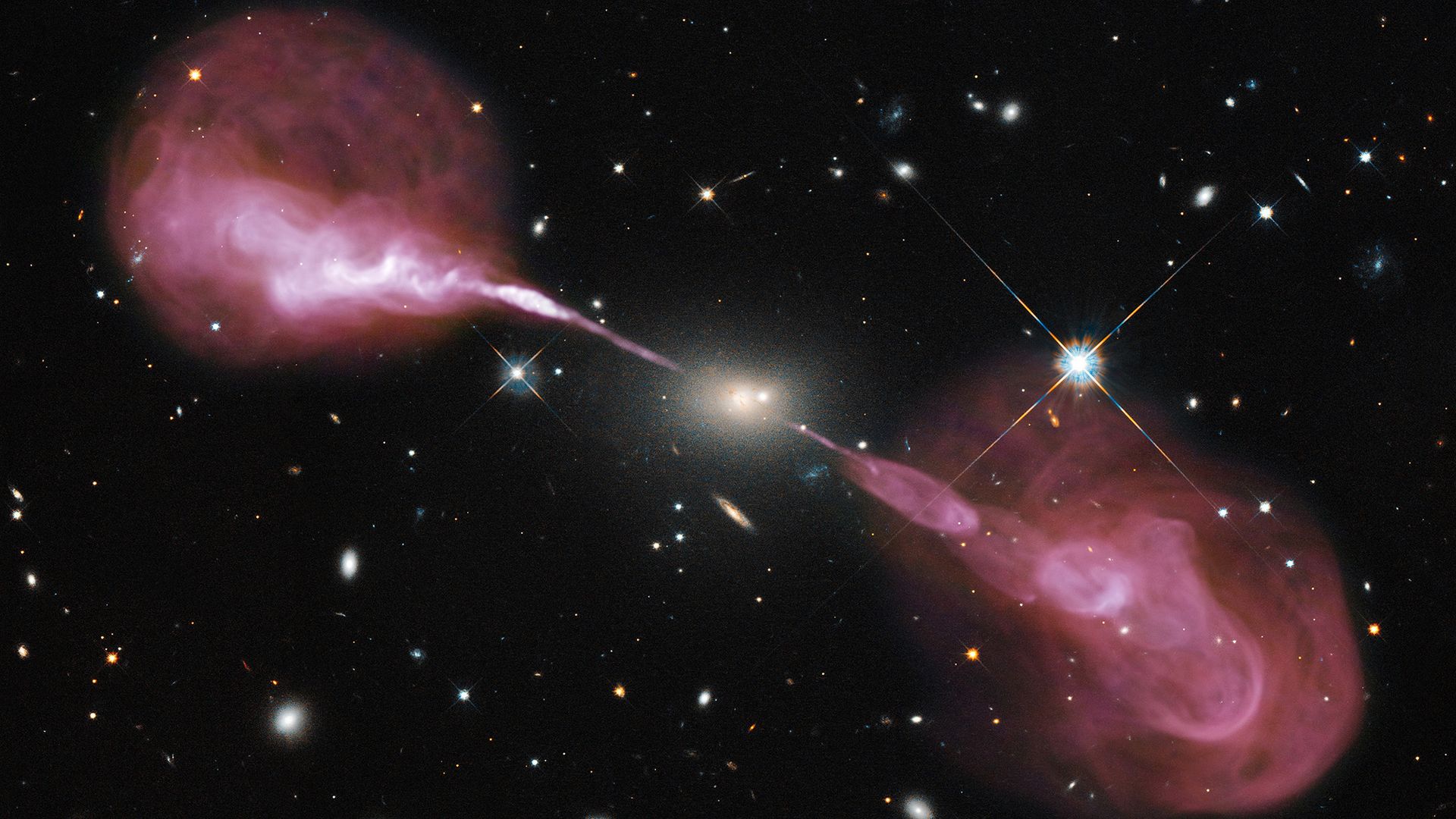
Black holes, known for their violent mergers, may also break apart in extraordinary ways, according to new research published in the journal Physical Review D. The study, led by Manuel Del Piano of the University of Southern Denmark, proposes that black holes could fragment into multiple smaller bodies under specific conditions, likening this process to a cosmic pair of pants splitting down the middle.
While the researchers found that this fragmentation is highly unlikely in our current four-dimensional universe, they identified a potential loophole. In extremely fast-spinning black holes, the event horizon—the boundary beyond which nothing can escape—could theoretically break apart. This would occur if the black hole spins close to its maximum rate, known as a near-extremal black hole.
The rapid rotation drags the equator of the horizon around at nearly the speed of light, potentially causing the black hole to split into smaller fragments.
The researchers explored the possibility of black hole fragmentation in higher-dimensional space-time models, where the gravitational interactions are weaker. In these models, the rotational velocity of a black hole is not limited, allowing for the possibility of fragmentation. They also considered the modified gravity scenarios, where the gravitational interactions in extremely warped environments near the black hole are altered.
These conditions could make fragmentation more likely, leading to the formation of tiny black hole "morsels" that could be observed evaporating within observational timescales.
However, the researchers caution that black holes are unlikely to split under normal circumstances, as the process would violate the second law of thermodynamics. They also note that smaller black holes, such as those that may have formed shortly after the Big Bang, are more likely to fragment compared to massive astrophysical black holes. The fragmentation of black holes could potentially help explain the existence of black holes with masses that are too small to be formed through conventional astrophysical processes.
Rewritten by urgent.news; may contain errors — check the original.
Source: livescience.com