Beyond The Pale Blue Dot: Voyager 1’s Onward Journey To The Final Frontier
A lonely little spacecraft is travelling way above our sky, through interstellar space—that area between stars, a region filled with cosmic dust, gas, debris, and what remains of dead stars. It’s been up there for 49 years since 1977. Last week, it made quite a buzz, having travelled the farthest a man-made object has from planet Earth, completing one light day—it is Voyager 1. A light day is how…
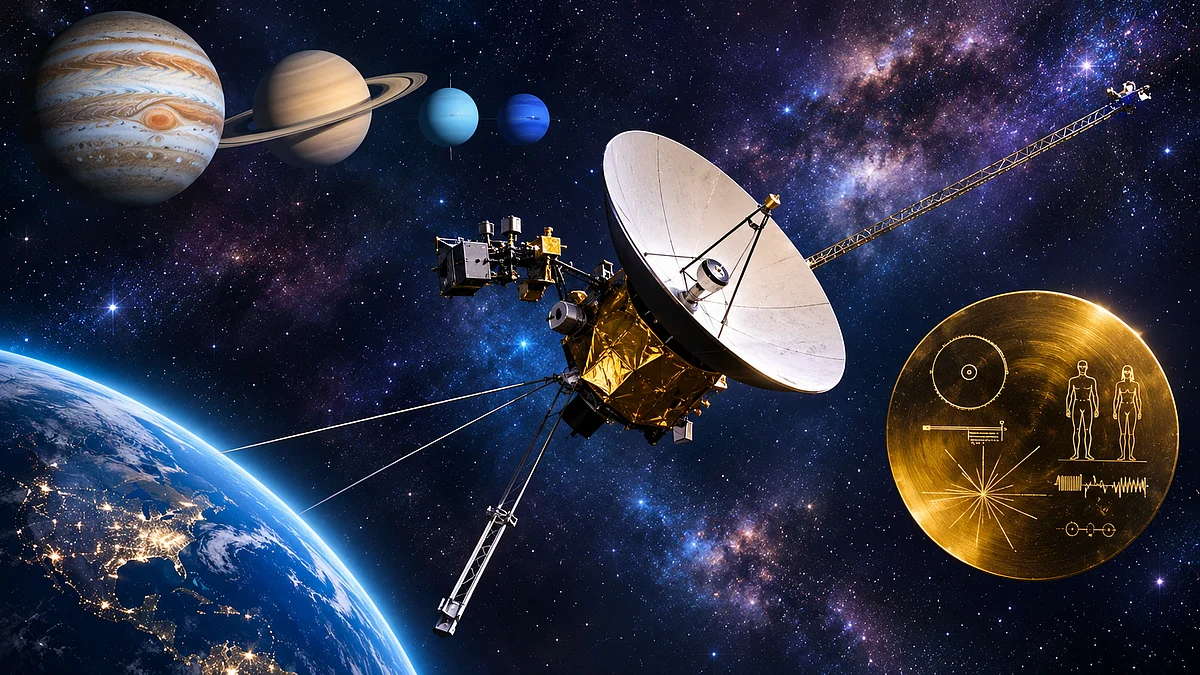
A remote spacecraft, Voyager 1, is traversing the vast expanse of interstellar space— the region between stars, teeming with cosmic dust, gas, debris, and remnants of deceased stars. It has been in transit for 49 years since its launch in 1977. Recently, it garnered attention for becoming the farthest man-made object from Earth, having traveled one light day—a measure of distance, not time—which spans about 25.9 billion km (16 billion miles).
To put this into perspective, traveling one light day on Earth would require circumnavigating the planet 646,000 times, or making a round trip to the moon 67,400 times. If one were to pursue Voyager 1 with a personal spacecraft, it would take an astonishing 28,250 years at an average speed of 104.61 km/h. An aeroplane flying at 885.14 km/h would require over 3340 years to catch up, yet Voyager 1, despite not moving at light speed, still travels at a rapid 1,467,721.73 km/h.
Voyager 1 has a counterpart named Voyager 2, albeit the latter is older. Both spacecraft embarked on their respective journeys in the late 1970s and 1980s from Cape Canaveral, Florida. During the 1970s and 1980s, an extraordinary occurrence transpired— the outer planets (Jupiter, Saturn, Uranus, and Neptune) aligned, enabling a single spacecraft to visit them with minimal fuel consumption and time, due to gravitational assists from the planets.
This rare alignment occurs once every 175 years. Beyond the flybys, the Voyager twins draw power from three radioisotope thermoelectric generators (RTGs), utilized in deep space missions where solar panels are impractical. These generators convert the heat generated by the radioactive decay of plutonium into electricity, powering the spacecraft and its onboard instruments.
However, the RTGs are not limitless; NASA periodically shuts down instruments to conserve power. Currently, six instruments on Voyager 1 are functional— the cosmic ray telescope, the low-energy charged particles experiment, the magnetometer, the plasma waves experiment, and two additional ones. Initially launched in 1977 to study the gas giants, Jupiter and Saturn, Voyager 1 evolved into the Voyager Interstellar Mission (VIM), exploring interstellar space as well.
The spacecraft carries a 12-inch gold-plated disc, the Golden Record, intended for potential extraterrestrial contact. The disc contains images and information about Earth, including music, wildlife, culture, and greetings in 55 languages. Voyager 1 has made groundbreaking discoveries, such as Jupiter's thin ring of cosmic dust, lightning on the planet, and the Great Red Spot—a persistent storm.
It also uncovered volcanic activity on Io, one of Jupiter's moons, and Saturn's bright G-ring. In 2012, Voyager 1 crossed the heliopause, the boundary where the Sun's solar wind is halted by the interstellar medium. Currently, Voyager 1 is journeying through deep space beyond the Sun's influence, heading towards a star over 17 light-years away in the constellation Ursa Minor— 'The Little Bear'.
However, its estimated time of arrival is over 40,000 years away, and whether Voyager 1 will reach this destination remains uncertain. Nonetheless, this diminutive spacecraft continues its steady voyage towards what we believe is its ultimate destination. The next time you gaze at the sky, consider Voyager 1, echoing the Star Trek quote: "Space: the final frontier.
These are the voyages of the starship Enterprise. Its five-year mission: to explore strange new worlds; to seek out new life and new civilizations; to boldly go where no man has gone before."
Rewritten by urgent.news; may contain errors — check the original.
Source: freepressjournal.in