Detecting Blocked Rain Gauges for Reliable Weather Data
When rain gauges are blocked or broken, they present faulty data. Various methods to detect faulty instruments may work better in different regions, according to new research.
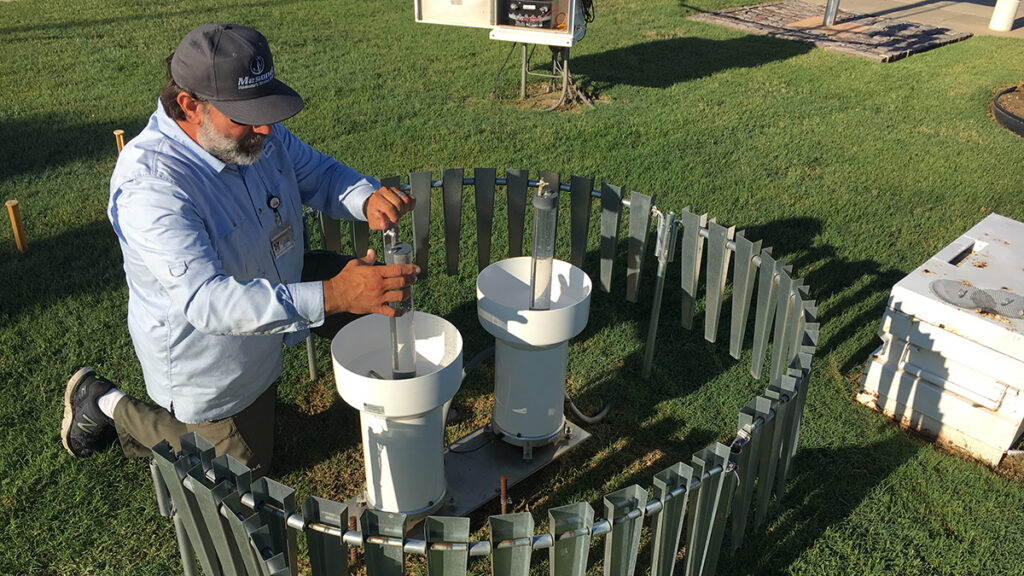
Accurate weather data is essential for various aspects of daily life, such as planning outings, planting crops, and preparing for disasters. However, rain gauges in weather networks can become blocked by dust, spiderwebs, or other obstructions, leading to unreliable rainfall data. Irené Tematelewo, a data scientist at Microsoft and former member of the quality control team for the Trans-African Hydro-Meteorological Observatory (TAHMO), highlighted this issue in a recent study.
Weather networks employ several methods to detect faulty rain gauge data. At the Oklahoma Mesonet, a ground-based weather network operated by the University of Oklahoma and Oklahoma State University, blocked gauges are a common problem. Meteorologist Chris Fiebrich explained that the network compares rain gauge data to weather radar and installs rain gauges in pairs to identify discrepancies in readings.
In networks like TAHMO, which lacks access to weather radar and the resources to install paired rain gauges, scientists must rely on algorithms to identify clogged rain gauges. Tematelewo and her team tested four commonly used algorithms on both the TAHMO network and the Oklahoma Mesonet. They introduced fake faulty data points to assess the effectiveness of each algorithm in detecting these anomalies.
The study found that some algorithms require dense station spacing, making them unsuitable for sparse weather networks like TAHMO. In the Oklahoma Mesonet, the algorithms performed well due to the high correlation between neighboring gauges' rainfall measurements. However, in the TAHMO network, the lack of correlation between neighboring gauges, even with a denser station layout, made detection difficult.
The researchers speculate that differences in terrain and climate across Africa may contribute to the poor performance of the algorithms in the TAHMO network. Africa's precipitation patterns can vary drastically over short distances, while Oklahoma's rainfall patterns are more uniform. Tematelewo suggests that increasing the density of rain gauges or installing redundant gauges in TAHMO could improve data quality control.
Additionally, using multiple algorithms simultaneously may enhance detection accuracy in developing networks like TAHMO.
Written by urgent.news from Eos's reporting — not their text. Machine-written — may contain errors; check the original before relying on it.