These Robotic Arms Are Powered by Algae. Watch How They Move
The key to the movement of these flexible robots is the algae’s photosynthetic capabilities.
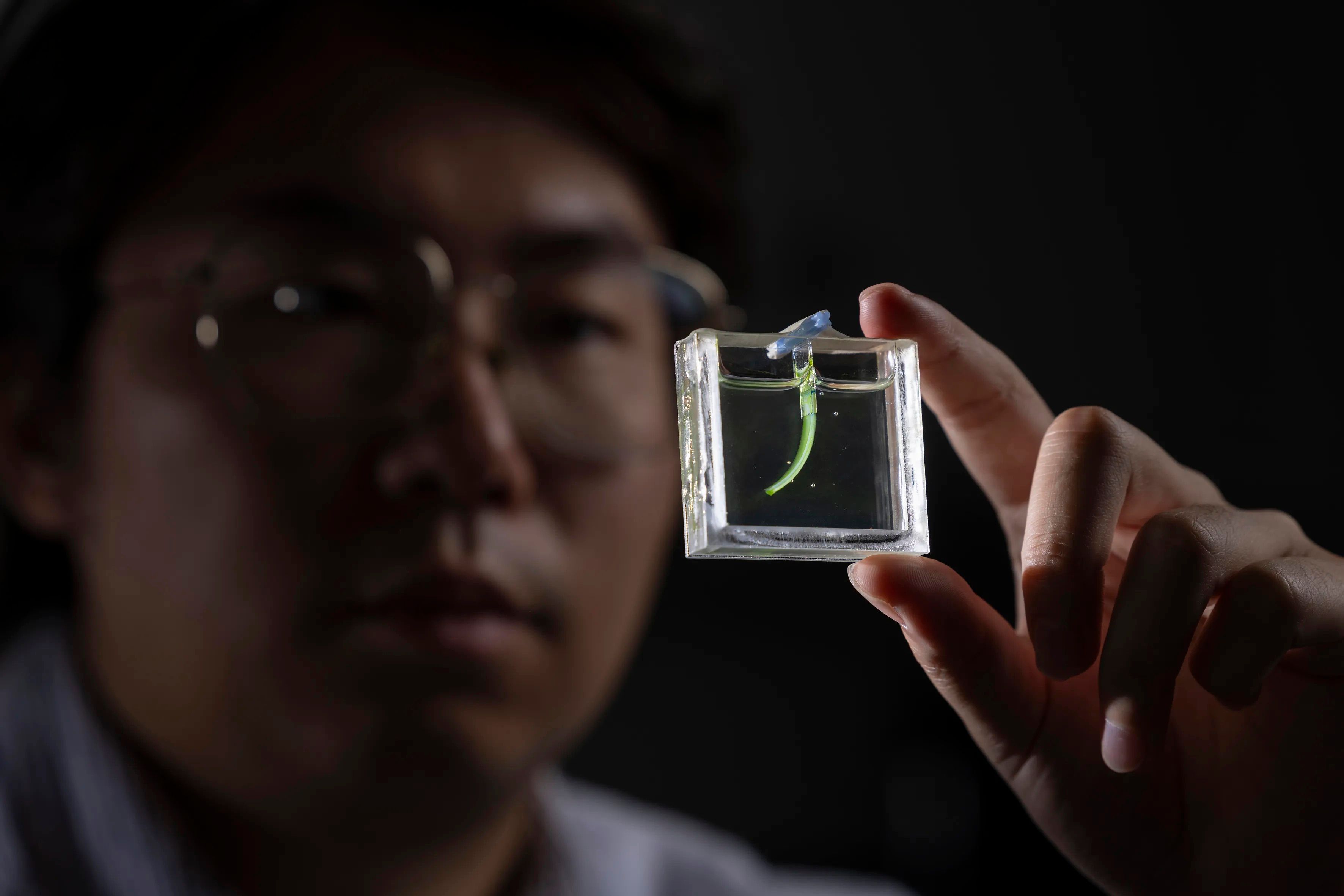
Soft robotic arms that move by harnessing the power of algae have been developed by researchers at Delft University of Technology in the Netherlands. Unlike traditional robots, these bioactuators utilize living cells to generate motion, attracting significant attention in recent years. The research team, led by Marie-Eve Aubin-Tam, aimed to integrate living materials into functional materials to explore the possibilities that arise from this integration.
The robotic arms, each about three-quarters of an inch long, are constructed from two layers of hydrogel that the algal cells thrive on. When light strikes the algae, they initiate photosynthesis, absorbing carbon dioxide and fixing nitrogen, which raises the local pH and causes one of the hydrogel layers to swell. Conversely, when it becomes dark, the algae release carbon dioxide through respiration, decreasing the pH and causing the gel to shrink, resulting in the bending of the arm.
This pH-responsive hydrogel layer demonstrates a high degree of local sensitivity to algae activity, making it ideal for applications where minimal environmental impact is desired.
While the robots may not be the fastest, their chemical shift is apparent relatively quickly—within 20 seconds of light application and 10 seconds of darkness. However, it takes several hours for the hydrogel to bend significantly. The team constructed various algal devices, including a four-fingered gripper that closes in response to light and successfully grasps and lifts a lightweight object. Another hook-shaped gripper demonstrated the ability to pick up and release a rubber ring with great dexterity.
These soft robots are highly energy-efficient, requiring only light as an external energy source and no complex mechanical parts. Microalgae, the primary component of these robots, are largely self-sustaining, providing the potential for long-term operation with minimal external input. This technology holds promise for developing autonomous, environment-responsive soft robots that could be utilized in various applications, including agriculture, fluid control in lab-on-a-chip devices, and underwater robotics systems.
The use of non-genetically modified algae eliminates biosafety concerns often associated with microbe-based technologies, making these robots exceptionally environmentally friendly as they can absorb carbon dioxide while deriving energy from sunlight.
Written by urgent.news from Wired Science's reporting — not their text. Machine-written — may contain errors; check the original before relying on it.