How to predict the behavior of molecules from scant data
A machine-learning approach called CheMeleon provides a practical way to develop new drugs or other molecules with much less detailed, expensive experimentation.
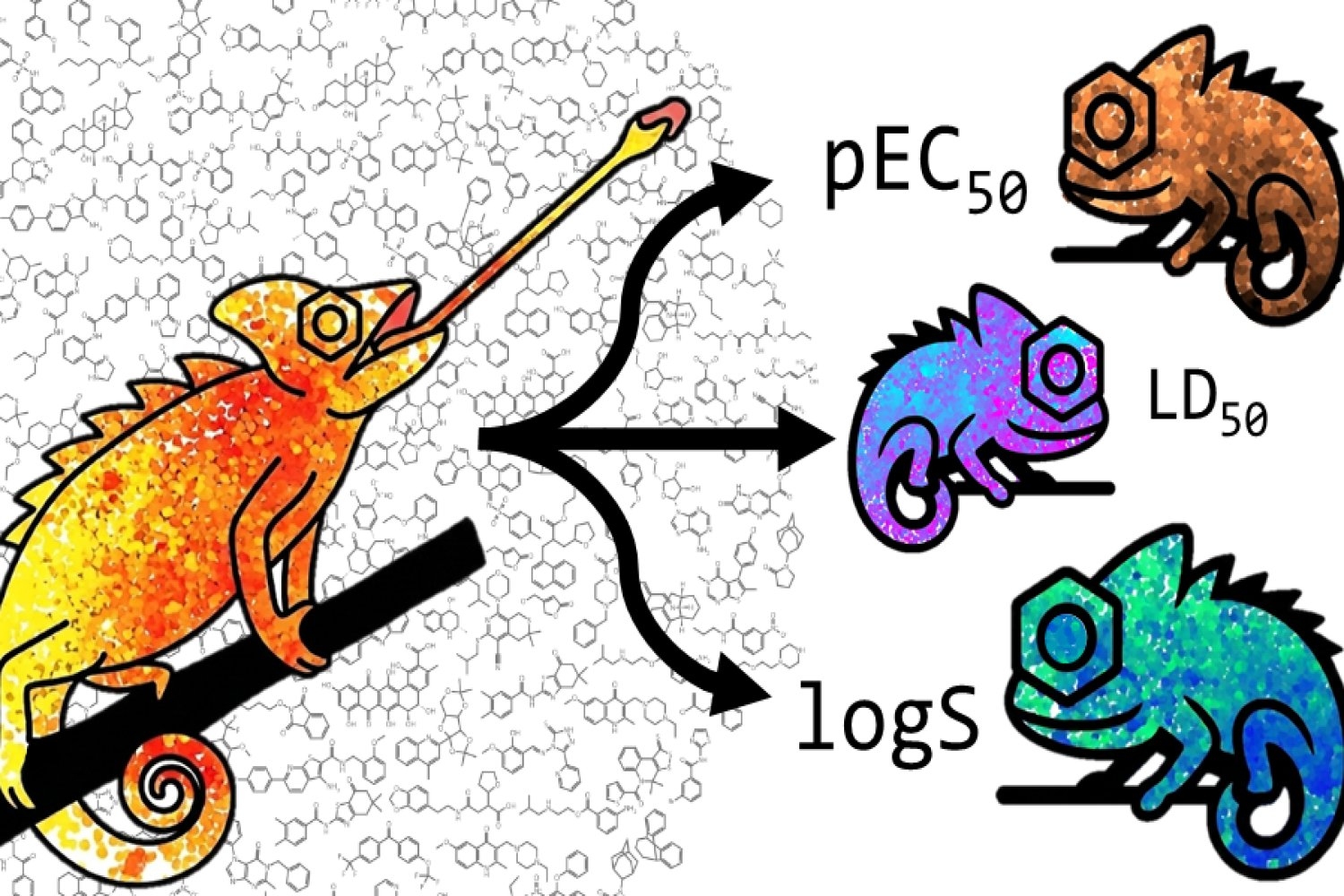
Predicting the behavior of molecules with limited data is crucial for progress in various industries, such as pharmaceuticals, electronics, and energy. Currently, there is no perfect method to determine how a chemical compound will behave in terms of different properties and responses. Recent advancements in artificial intelligence and machine learning have aided in supplementing or accelerating laborious calculations based on physical principles, providing initial guidance on which compounds to synthesize and test.
A new method developed at MIT outperforms existing methods when there are few data points on a technologically relevant property, such as ligand affinities for a target protein in a potential drug. This approach was reported in the September 14 issue of the Journal of Chemical Information and Modeling by MIT graduate student Akshat Shirish Zalte, recent graduate Jackson Burns PhD '26, Research Scientist Charles Abreu, Professor William Green, and three researchers from the chemical company BASF.
The paper has already gained traction, with nine of the top 20 entries in a recent contest using CheMeleon, the open-source model developed for the task. The foundation of CheMeleon lies in pre-training a machine-learning model with data from a million different molecules, enabling it to learn correlations between molecular structure and behavior with respect to about 1,600 descriptors developed by chemists over time.
CheMeleon can then be fine-tuned to predict various properties, including solubility, viscosity, bioactivity, and reactivity, for a specific protein or enzyme. This pre-trained foundation model, inspired by language models like ChatGPT and Claude, uses molecular descriptors from the PubChem database, allowing it to learn underlying patterns and relationships without requiring extensive literature data.
Compared to classical models that rely on manually inputting expert knowledge, CheMeleon can achieve good performance with just a few data points for the specific task at hand. The model's performance was verified by comparing it against other foundation models and classical models, with CheMeleon emerging as the top performer in 58 test cases.
By drastically reducing the number of molecules that need to be tested experimentally, CheMeleon saves time and money in the drug discovery process.
Written by urgent.news from MIT News Research's reporting — not their text. Machine-written — may contain errors; check the original before relying on it.
This story
This is one outlet's version. Read the fullest account.