What Happens When the Model Reads It Wrong: Building LLM Compliance Review That Survives an Audit
Lessons from cutting manual compliance review by 60% with OCR and LLMs at a bank, and how to design for the moment the model reads a document wrong.
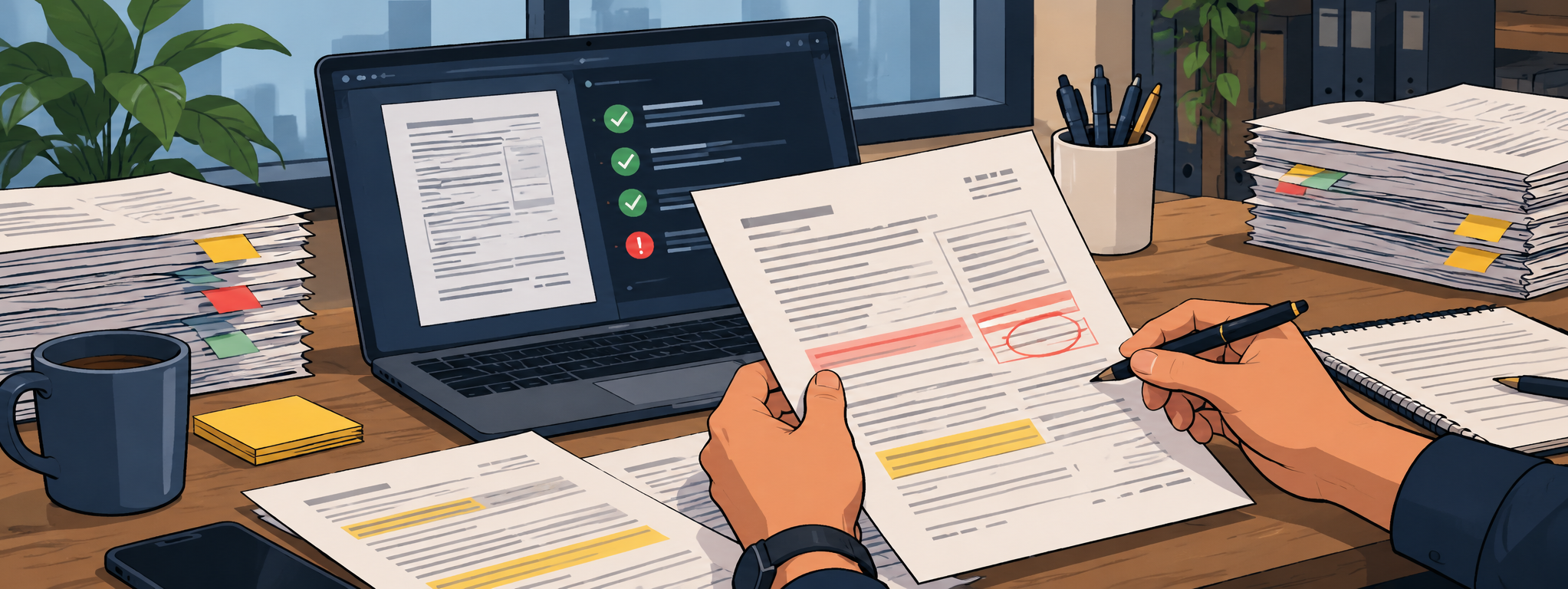
In the compliance review process for AI-enabled OCR and large language model (LLM) workflows, false alerts are less costly than missed violations. False alerts waste analyst time, while missed violations can lead to regulatory findings. This understanding of error asymmetry guided my work on building AI-enabled compliance systems.
Building AI-enabled OCR and LLM workflows reduced manual review effort by about 60%. However, the engineering time was mostly spent on handling cases where the model misread a document or made incorrect decisions. The challenge lies in making the model's decisions explainable, as auditors can request explanations for cleared documents.
Compliance review is a complex domain for LLMs due to two main problems. First, a system's overall accuracy may seem high, but it can still miss critical violations. Second, every decision must be thoroughly explainable, with the model's reasoning traceable to specific text and system version.
A prototype of such a system can seem impressive with clean documents and accurate reasoning. However, it fails to account for the challenges present in real-world scenarios. Issues like extraction loss, rationales that can't be verified, and handling rare document formats can lead to significant problems in production.
To address these challenges, I propose a design that starts with assessing where a document goes when a component fails. OCR confidence should be scored per page, and any page with low confidence should trigger a review before the LLM processes the document. Additionally, adding a layout fingerprint, based on structural features, can help identify documents that don't match any evaluation template and automatically route them for review.
Another crucial aspect is replacing the general "is this document compliant?" question with narrow checks per rule. Each check should provide structured output, such as verdicts (pass, fail, insufficient evidence) and evidence quotes, with short rationales capped in length. This ensures that auditors can trace decisions back to specific text and system versions, providing a verifiable trail for compliance review.
Written by urgent.news from HackerNoon's reporting — not their text. Machine-written — may contain errors; check the original before relying on it.