When AI Works Perfectly, What Happens to Human Life?
What happens when AI gets the answer right but misses the human experience? Explore how LIFE uses fiction and microdrama to examine AI's limits.
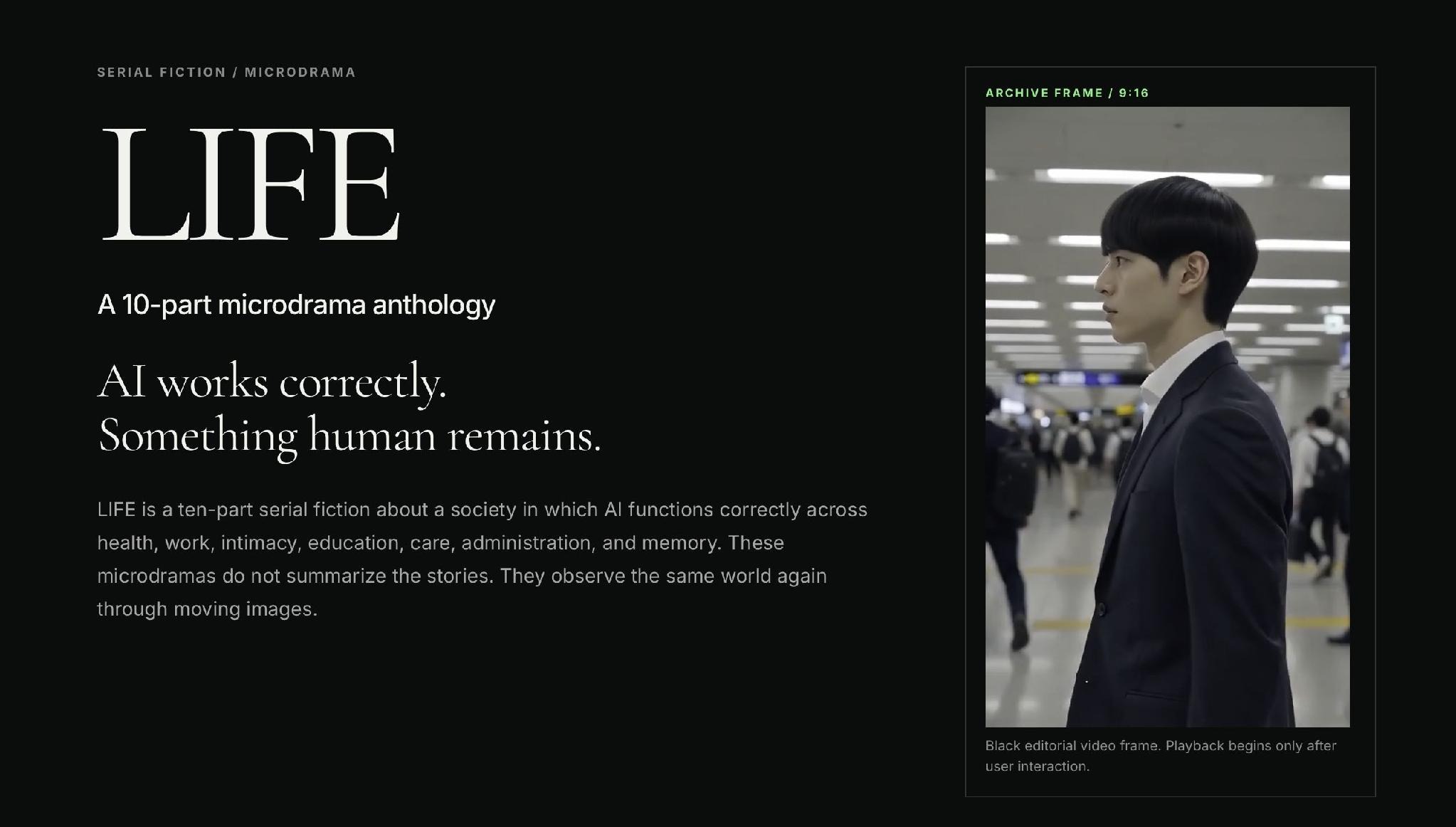
When artificial intelligence performs flawlessly, it prompts a question about the future of human life. While reports indicate optimal functioning, the report cannot capture the subtle nuances experienced by individuals. These sensations are often attributed to anxiety, fatigue, or minor discomfort, but the person may struggle to distinguish between them.
The data may be accurate, yet the life that continues afterward presents a contradiction. This scenario serves as the starting point for a work of fiction called LIFE, created by SHIRO & Co., which explores the possibility that the world could remain recognizable despite certain essential aspects becoming difficult to define.
In the realm of human interactions, friction plays a crucial role. It represents the pause before making irreversible decisions, such as being inexperienced, unsure about a relationship, or unable to explain why a familiar place feels different. Some of these experiences may be painful or unnecessary, but they are not always defects waiting for correction.
For instance, a young person applying for their first job may be rejected due to a lack of experience, even though the evaluation system accurately assesses qualifications and makes fair comparisons. The question arises: where does experience begin in a society that increasingly demands it before granting entry?
A related concern arises when considering a future in which artificial intelligence provides increasingly accurate predictions. In one story, a thirteen-year-old is faced with a future already arranged based on stability and probability. While the recommendations are sensible, the person whose future is being predicted has not yet fully developed.
The future person will be shaped by experiences, disappointments, friendships, accidents, and desires that have yet to occur. Recommendations can illustrate likely outcomes, but they cannot encompass every possibility that will emerge from living. There is a distinction between helping someone envision a future and deciding in advance which future is worth imagining.
As prediction becomes more persuasive, it becomes increasingly challenging to disagree with the optimal choice. However, the freedom to become someone unexpected often depends on the right to make choices whose value cannot be demonstrated beforehand.
Memory also presents a challenge for artificial intelligence. Even if information is preserved and reproduced, such as an old message left on an online bulletin board, the original conversation may have ended, participants changed, or even disappeared. The message remains, but what exactly has survived? A person's words are distinct from their continued presence, and a convincing response does not restore the circumstances of an earlier conversation.
Yet, such responses may evoke emotions, provide comfort, or feel true, even if they are not the same as the person's continued existence.
Written by urgent.news from HackerNoon's reporting — not their text. Machine-written — may contain errors; check the original before relying on it.