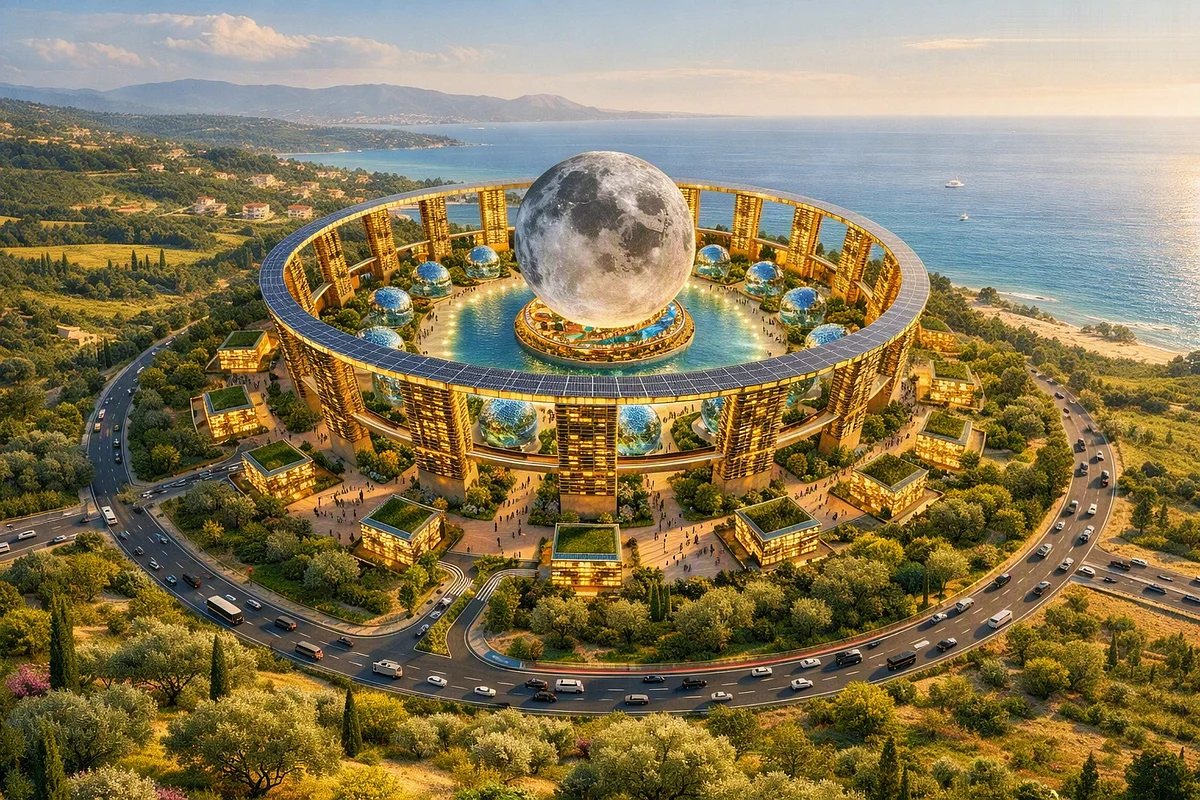
Virtual tourism could get more realistic: Model builds panoramas
Researchers have developed an artificial intelligence (AI) model to generate realistic panoramic images for virtual tourism. The work has potential applications in cultural heritage preservation and destination marketing, the team suggests. Details are reported in the International Journal of Information Quality.

Researchers have designed an AI model, named SGMSD-Net, to produce photorealistic panoramic images for virtual tourism. This innovation could prove useful for cultural heritage preservation and destination marketing. The International Journal of Information Quality has published details of the work. The new model tackles a common issue with AI-generated tourism images, where the pictures are convincing but do not accurately reflect the real scene.
SGMSD-Net utilizes semantic guidance to interpret scene meaning and diffusion modeling to generate images through multiple refinement stages. The process involves three resolution stages to establish the overall image structure, then adding textures and lighting details. The researchers tested the model on two datasets, SUN360 and Matterport3D, and found it outperformed four existing methods in image quality, perceptual similarity, and alignment with scene descriptions.
Subjective evaluations also confirmed the generated scenes were clear and consistent. The technology could enable virtual tours allowing potential visitors to explore destinations before traveling. It might also be used in educational reconstructions of historical sites that are hard to access or require protection for conservation purposes.
Future research will examine combining SGMSD-Net with three-dimensional reconstruction and multimodal AI systems to create a more interactive virtual destination representation.
Written by urgent.news from Phys.org's reporting — not their text. Machine-written — may contain errors; check the original before relying on it.