Talks are the only way out, China tells Iran as US threat hangs over Middle East
China’s top diplomat has again stressed the need for a political settlement to strife in the Middle East, telling a senior Iranian official in Beijing on Monday that armed conflict was not the way out. “As conflicts in the Middle East drag on and risk further spillover, dialogue and negotiation remain the only viable path forward,” Wang Yi told Ali Bagheri Kani, deputy secretary of Iran’s Supreme…
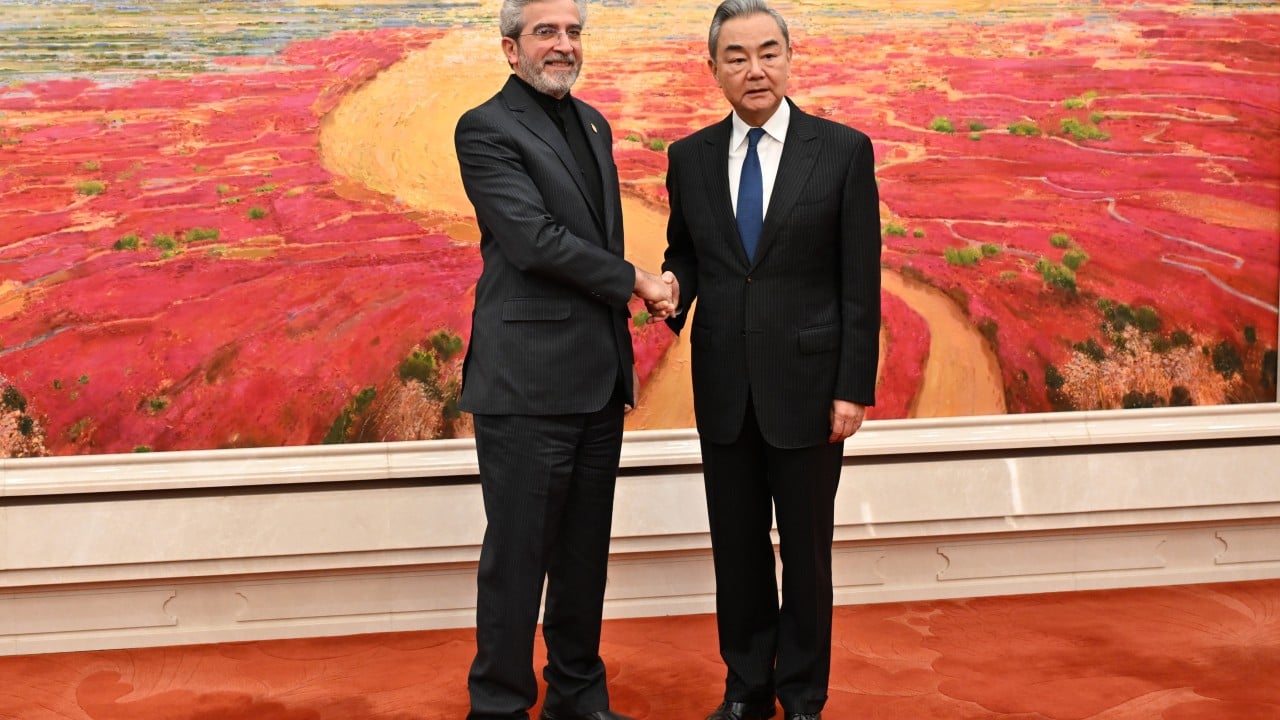
China’s top diplomat, Wang Yi, reiterated on Monday that a political resolution is the only solution to the ongoing turmoil in the Middle East. Addressing Ali Bagheri Kani, Iran’s deputy secretary of the Supreme National Security Council, Wang cautioned that armed confrontations were not the answer. He emphasized that dialogue and negotiation should be the primary focus, stating that “all parties should … focus on a political settlement in a rational and pragmatic spirit instead of resorting once again to armed conflict.”
China also announced that three special envoys would embark on a series of missions across the Middle East, the Red Sea, and the Horn of Africa, beginning in early November. These envoys, Zhai Jun, Liu Xianfa, and Hu Changchun, will visit Iran, Oman, Saudi Arabia, Ethiopia, Djibouti, Egypt, and Eritrea, respectively. Their objective, according to China’s foreign ministry spokeswoman Mao Ning, is to facilitate talks for peace, mitigate tensions, and contribute to regional stability.
The diplomatic push follows a potential escalation between the United States and Iran, which could reignite after the US midterm elections on Tuesday. US President Donald Trump has hinted at the possibility of resuming military operations against Iran post-election. Iranian Supreme Leader Khamenei has vowed "immediate, impactful" retaliation without geographical boundaries if the US takes further steps.
Some Gulf Arab states have reportedly received US alerts to prepare for a possible "short and intense" military campaign against Iran in the aftermath of the elections.
Meanwhile, tensions between Saudi Arabia and Yemen's Iran-backed Houthi forces have intensified following a series of cross-border missile and drone strikes on Saudi targets. These attacks jeopardize crucial shipping lanes in the Red Sea. Egypt, situated at the northern entrance of the Red Sea via the Suez Canal, and Eritrea and Djibouti in the Horn of Africa border the Bab el-Mandeb Strait, which separates the Red Sea from the Arabian Sea.
Both Djibouti and Ethiopia play significant roles in Red Sea maritime access, with Djibouti hosting foreign military bases, including Chinese ones. Last month, both China and Djibouti's foreign ministers called for secure international shipping routes through the Red Sea, the Horn of Africa, and the Bab el-Mandeb Strait. Additionally, Omani Sultan Haitham bin Tariq met with Chinese President Xi Jinping in Beijing, where Xi cautioned against the Middle East turning into a stage for great-power rivalry and geopolitical conflict.
Written by urgent.news from Reuters Business via SCMP's reporting — not their text. Machine-written — may contain errors; check the original before relying on it.
This story
This is one outlet's version. Read the fullest account.
- As Trump eyes new attack, Iran vows to retaliate beyond the Mideast and target financial assets, while oil markets brace for generational damage fortune.com
- Iran offers 48-hour Hormuz reopening plan as Trump signals progress in talks hellenicshippingnews.com
- Oil falls as report says Trump to give Iran diplomacy more time straitstimes.com
- Oil falls as Trump favours Iran diplomacy before midterm elections investing.com
- Talks are the only way out, China tells Iran as US threat hangs over Middle East scmp.com