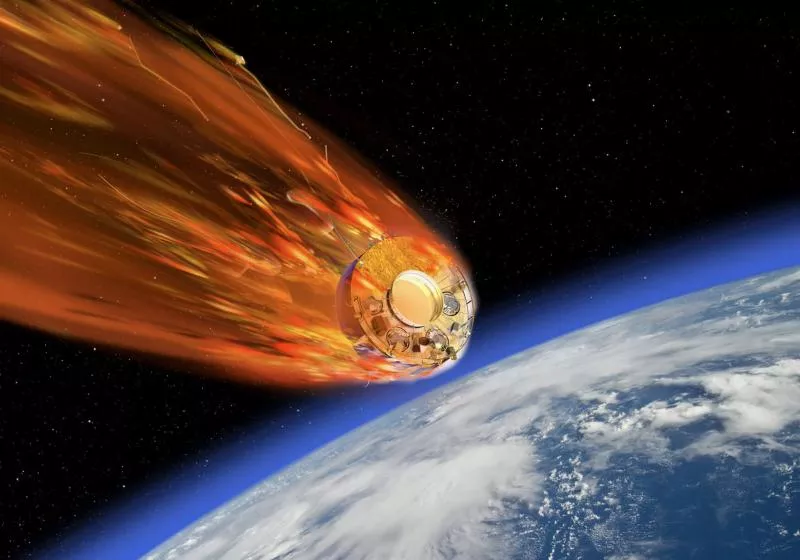
NASA telescope is plunging back to Earth after 22 years in orbit
The Swift Observatory is barely clinging to space after a failed rescue effort left it tottering lower and lower.
After two decades in orbit, NASA's Swift Observatory is set to re-enter the Earth's atmosphere and descend towards Earth, likely crashing down on Wednesday. The 1.5-ton telescope is expected to mostly burn up during re-entry, but some dense tungsten and mirror components might survive. As of Monday, the U.S. Space Force predicts the spacecraft will re-enter at 3:30 a.m. EST, November 4, with an uncertainty of 11 hours.
Most of the reentry zone spans Africa, Australia, India, Southeast Asia, and Central and South America. The likelihood of harm to anyone on Earth is estimated at 1 in 2,100. NASA and the Space Force will continue monitoring and updating re-entry predictions. The Swift team mourns the telescope's end but remains grateful for its 22 years of cosmic observations.
Swift, launched in November 2004, searched for major universe explosions like gamma-ray bursts and supernovas. Its unique swiveling ability made it a first responder for other space telescopes. Despite rescue attempts, the telescope's low orbit and intense solar activity accelerated its descent. NASA estimates Swift detected over 2,000 gamma-ray bursts and 1,400 exploding stars during its mission.
Scientists now seek to fill the gap left by Swift's retirement, hoping its lessons can benefit future space missions.
Written by urgent.news from CBS News's reporting — not their text. Machine-written — may contain errors; check the original before relying on it.
Also reported by 1 other outlet
- NASA's Swift space telescope is about to crash to Earth r.smartbrief.com