Muturi accuses Gachagua of political bullying as Mt Kenya turf wars deepen
Muturi has accused Rigathi Gachagua of political bullying and self-sabotage, as rivalry between their parties over control of the Mt Kenya political base threatens to complicate United Opposition unity ahead of the 2027 elections.
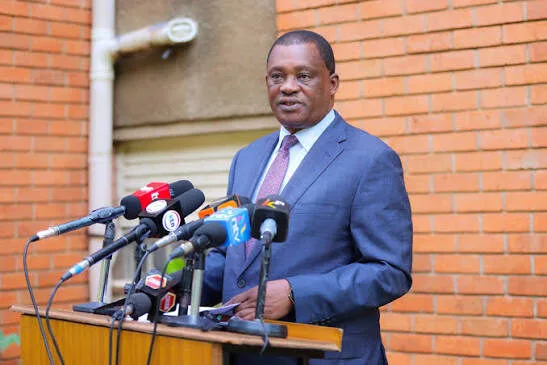
Nairobi, Kenya - Democratic Party leader Justin Muturi has criticized former Deputy President Rigathi Gachagua for allegedly engaging in political bullying and thwarting opposition unity ahead of the 2027 General Election, as tensions escalate between their parties over political clout in the Mt Kenya region. Muturi expressed concerns that Gachagua's pursuit of a tripartite political arrangement within the United Opposition could divide the coalition and diminish its prospects of defeating incumbent President William Ruto.
The ongoing dispute also highlights the rivalry between Gachagua's Democracy for the Citizens Party (DCP) and Muturi's Democratic Party (DP) as they strive to solidify their political foundations in Mt Kenya, a region expected to wield considerable influence in the 2027 presidential race. Both leaders have been vying for supremacy in the region's political landscape, intensifying the competition for support in the area.
In a vehement statement, Muturi questioned Gachagua's dedication to the shared presidential aspirations of the opposition's Wantam movement, urging him to cease political bullying, hypocrisy, and self-damage. He emphasized that a president cannot be elected based on support from a single community, asserting that a successful presidential campaign necessitates national consensus, strategic alliances, and the ability to unite voters from diverse backgrounds.
Muturi questioned the underlying motivation behind the push for separate political entities, wondering if it aims to bolster the opposition's presidential campaign or grant individual leaders more control over parliamentary seats, legislators, and devolved authorities. He cautioned that endorsing a tripartite setup could sow divisions within the opposition at a time when leaders should focus on a unified political strategy.
His remarks came amid the struggle for political supremacy in Mt Kenya, where Gachagua is attempting to strengthen his influence through DCP, while Muturi seeks to position the Democratic Party as a tool for political mobilization in the region. The rivalry underscores the uncertainty surrounding whether the two parties can collaborate in forming a united opposition coalition or if their rivalry over the same political constituency may complicate efforts to agree on a common presidential candidate.
Muturi maintained that coalition-building demands compromise, maturity, and strategic acumen, arguing that having three distinct political formations wouldn't guarantee victory in the presidential election. He cautioned Gachagua against viewing political partnerships as contests for dominance, stating that no individual or community possesses ownership of the United Opposition.
"No individual owns the United Opposition, and no community has a monopoly on Kenya's presidency. Political partnerships must be built on mutual respect, not ultimatums, political bullying, or supremacy contests," he stated. Muturi also referenced the political legacy of Gachagua's late brother, former Nyeri Governor Nderitu Gachagua, who won a gubernatorial contest against the TNA party, which produced former President Uhuru Kenyatta, despite support from the GNU.
He highlighted the complexities of political alliances and the fact that no political formation can claim sole ownership of the nation's political arena. Muturi cautioned that reducing presidential politics to ethnic calculations, regional strongholds, and individual bargaining power could undermine Kenyans' aspirations for political transformation.
He challenged opposition leaders to clarify whether they are constructing a unified national movement with a shared presidential ambition or establishing separate political entities whose leaders will negotiate individual interests post-elections. Muturi described the Komboa Kenya initiative as a national endeavor requiring sacrifice, discipline, strategic thinking, and a genuine commitment to a common goal.
He affirmed that the Democratic Party remains open to dialogue with leaders committed to constructive negotiations but would not tolerate intimidation or attempts to undermine its principles. "Kenya is bigger than any one politician. State House is the national prize. Unity must not be sacrificed at the altar of individual political survival," Muturi emphasized.
Written by urgent.news from Capital FM Kenya's reporting — not their text. Machine-written — may contain errors; check the original before relying on it.