I Built an AI Model That Outperformed AWS and Google on Image Moderation
I built Blue-Eye, a 303M-parameter image moderation model using free compute. On my 3,000-image benchmark, it outscored AWS and Google.
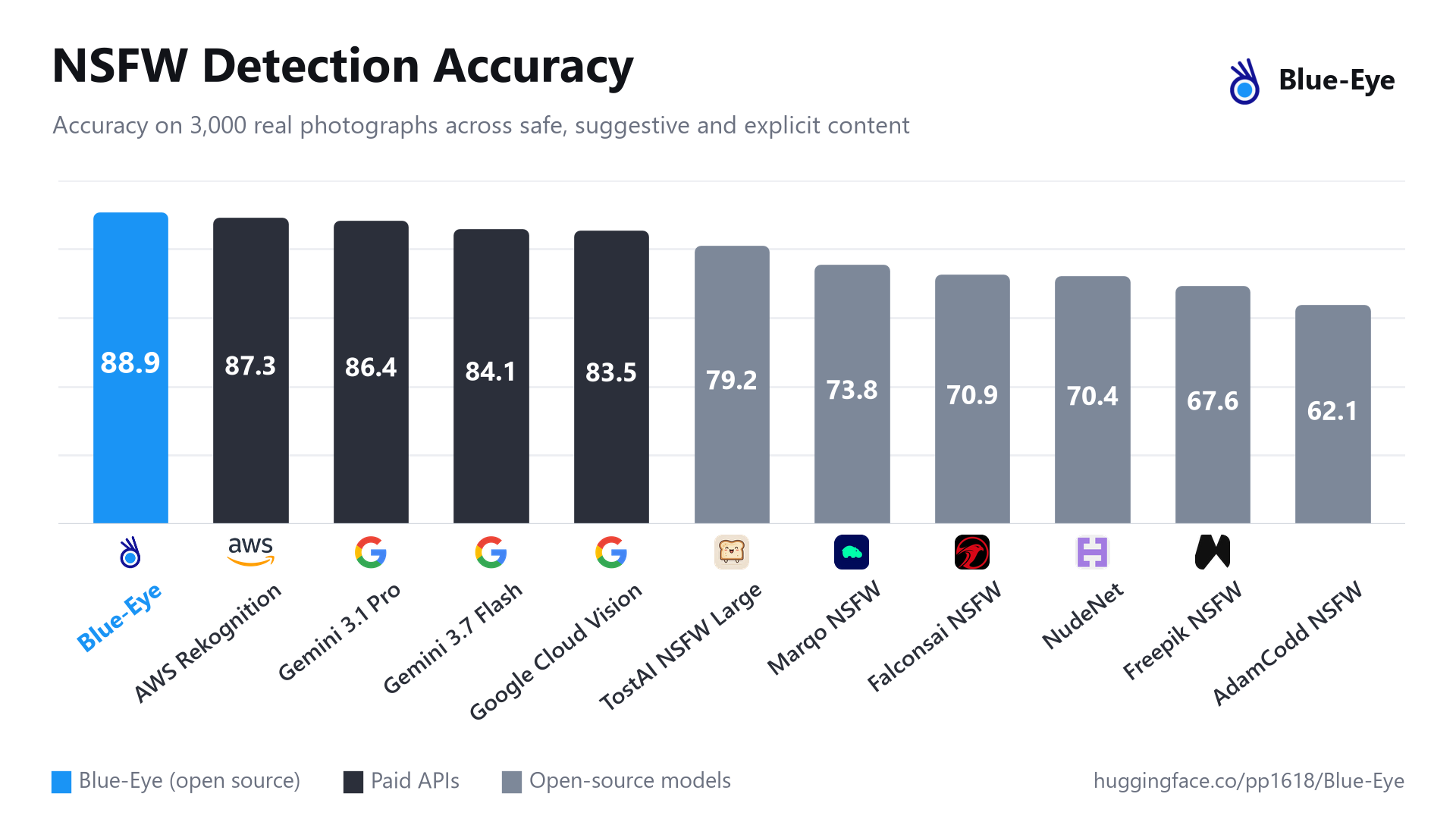
In the source, the author describes their journey in building an AI model called Blue-Eye that competes with popular cloud services like AWS Rekognition and Google Cloud Vision for image moderation. The author started the project to explore the feasibility of creating a model that could perform comparably to established commercial APIs, while having more control over the model's decision-making process.
Blue-Eye was developed using Meta's DINOv3 architecture, a pretrained vision transformer, and fine-tuned on approximately 2.6 million images, including both real photographs and anime or illustrated content. The model categorizes images into three classes: safe, suggestive, and explicit.
The author highlights the challenges of performing NSFW (Not Safe For Work) detection accurately, as nudity or exposed skin alone doesn't indicate explicit content. Ordinary images containing visible skin are common, and different platforms have varying policies regarding what should be allowed. The model uses three softmax scores to determine the category of each image, with developers able to adjust thresholds for moderation policies.
The author emphasizes the importance of using consistent training data and adjusting labels to ensure the model's effectiveness in distinguishing between the different categories.
For the training process, the author used Meta's DINOv3 ViT-L/16 as the backbone, adapting it for the classification task. Blue-Eye's input size was 512 × 512 pixels, and the classification head combined the transformer's class token with pooled features from other output tokens. The model had around 303 million parameters, which is considered substantial for an independently developed model.
The author trained the model in three stages, first adapting the backbone to the moderation task using real photographs, then mixing photographs with anime and illustrations, and finally refining the classifier across the three categories with class-balanced images. Training took two epochs per stage using AdamW with a one-cycle learning-rate schedule, label smoothing, image augmentations, and bfloat16 mixed precision with float32 master weights.
Written by urgent.news from HackerNoon's reporting — not their text. Machine-written — may contain errors; check the original before relying on it.