Scaling Agentic AI Coding Assistants in a Regulated Enterprise
How to scale agentic AI coding assistants to 600+ engineers in a regulated enterprise, using governance, guardrails, curated skills and approved integrations.
Agentic coding assistants can modify files, execute shell commands, and utilize tools for engineers, making them valuable for streamlining engineering processes. However, deploying these tools in a regulated enterprise environment presents significant challenges. Research on AI coding productivity yields mixed results, with some studies showing a 55.8% speed increase on certain tasks, while others report a 19% slowdown for experienced developers working with mature codebases. Therefore, enterprises must evaluate their own outcomes rather than relying on assumed gains.
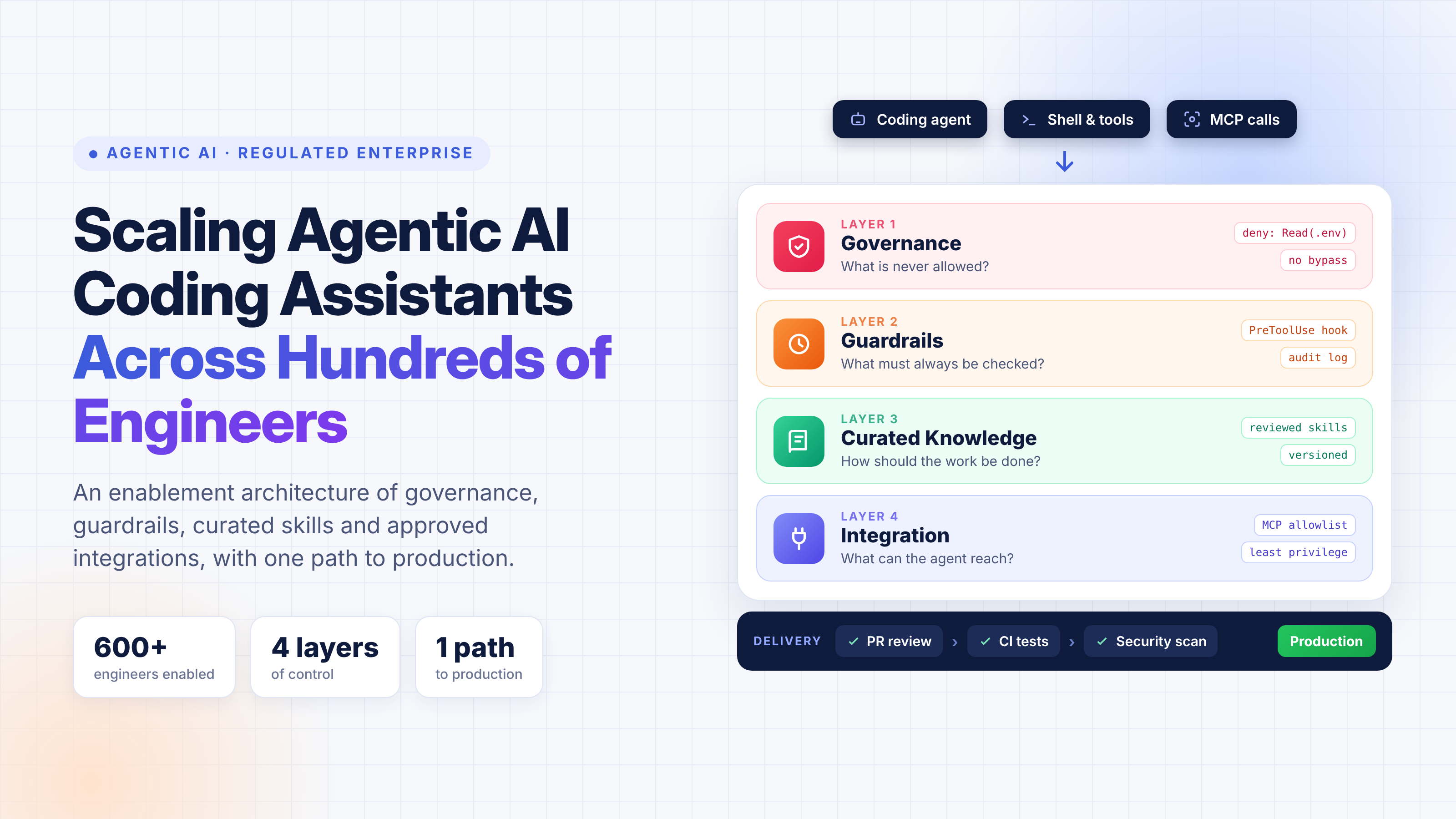
Agentic tools differ from autocomplete in that they actively read files, run commands, and interact with external systems. This distinction is crucial, as it shifts the primary control surface from prompts to permissions. Central to the proposed model is the implementation of centrally managed deny rules, deterministic hooks for policy enforcement, reviewed skills for repeatable workflows, and an allowlist of approved tool integrations.
To address the challenges in a regulated enterprise setting, the enablement architecture consists of four layers that are owned by various teams and address different concerns. The first layer, governance, focuses on defining what is never allowed. Central administration rules take precedence over user or project rules, following a deny-first approach where any rule that conflicts with a denial is prioritized. This layer also contains non-negotiable rules that cannot be overridden.
The second layer, guardrails, addresses the question of what must always be verified. This involves implementing pre- and post-action hooks and packaged know-how in the form of reviewed instruction files or skills. These mechanisms ensure that specific tasks are carried out consistently and securely, regardless of individual preferences or workflows.
The third layer, curated knowledge, centers around providing developers with repeatable instruction files or skills that outline how tasks should be performed. By curating and sharing this information, enterprises can improve the feedback loop and streamline the development process. This layer also emphasizes the importance of maintaining a consistent set of guidelines and best practices across the organization.
The fourth and final layer, integration, deals with determining what the agent can touch. This is achieved through an allowlist of approved tool integrations and Model Context Protocol (MCP) connections. MCP is an open JSON-RPC-based protocol that enables agents to connect to external systems, exposing tools, resources, and prompts. The protocol emphasizes the importance of obtaining user consent before invoking arbitrary code execution, although it cannot enforce this consent on its own.
In summary, the enablement architecture for agentic AI coding assistants in a regulated enterprise environment is designed to address the unique challenges posed by these powerful tools. By implementing a governance layer with central administration rules, a guardrails layer that verifies critical actions, a curated knowledge layer that shares best practices, and an integration layer that controls the agent's interactions with external systems, enterprises can harness the benefits of AI assistance while mitigating the associated risks.
Written by urgent.news from HackerNoon's reporting — not their text. Machine-written — may contain errors; check the original before relying on it.