Artificial nests help Hong Kong’s rare cockatoos cope with a ‘housing crisis’
In the urban landscape of Hong Kong, artificial nest boxes are providing shelter and research opportunities for one of the world’s most threatened parrot species. The yellow-crested cockatoo (Cacatua sulphurea) is critically endangered, with fewer than 2,000 individuals remaining across its native range in eastern Indonesia and Timor-Leste. However, Hong Kong hosts roughly 200 wild […]
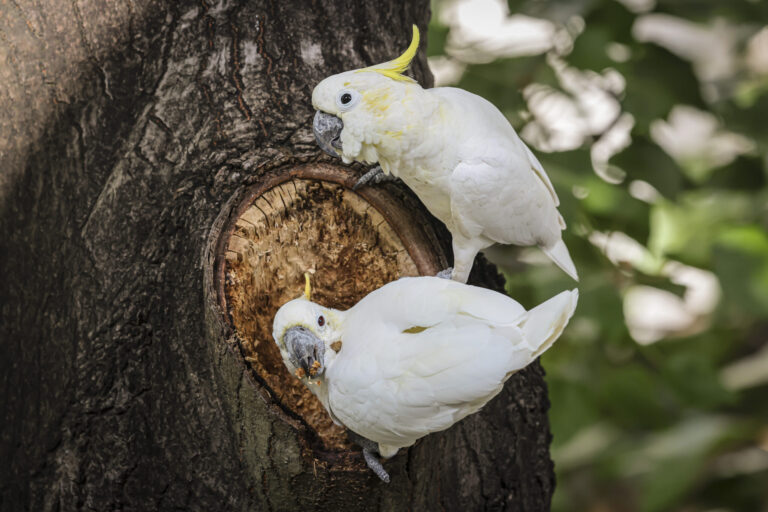
In Hong Kong, a housing shortage is threatening the survival of a rare parrot species. The yellow-crested cockatoo, one of the world's most endangered birds, has fewer than 2,000 individuals remaining in its native range of eastern Indonesia and Timor-Leste. However, Hong Kong is home to roughly 200 wild cockatoos, a tenth of the total population, believed to be descendants of escaped or released pets.
Despite strict legal protection and the absence of natural predators, the city's cockatoo population remains stable due to the lack of natural nesting sites. Over 60% of the birds' natural tree hollows have been destroyed by severe storm damage and tree pruning, leaving the birds with a desperate shortage of suitable nesting sites.
Astrid Andersson, a biologist and postdoctoral researcher at the University of Hong Kong, described the situation as a "housing crisis for these birds." To address this issue, Andersson collaborated with arborist and conservationist Harry Wong to establish HK Cockatoo Watch. Together, they developed artificial nest boxes adapted to Hong Kong's humid climate and equipped with internal cameras to monitor the birds' breeding behavior remotely.
Since March 2025, the team has installed 15 nest boxes in public parks and school campuses, actively involving local students in the project. Astrid Andersson emphasized the importance of coexistence with these endangered birds.
Written by urgent.news from Mongabay's reporting — not their text. Machine-written — may contain errors; check the original before relying on it.