The ‘Exotic Physics’ Behind a Mysterious 1,000-Mile Cloud on Mars
The cloud has baffled astronomers since its discovery in 2018. Now, a new study offers a possible cause for its appearance.
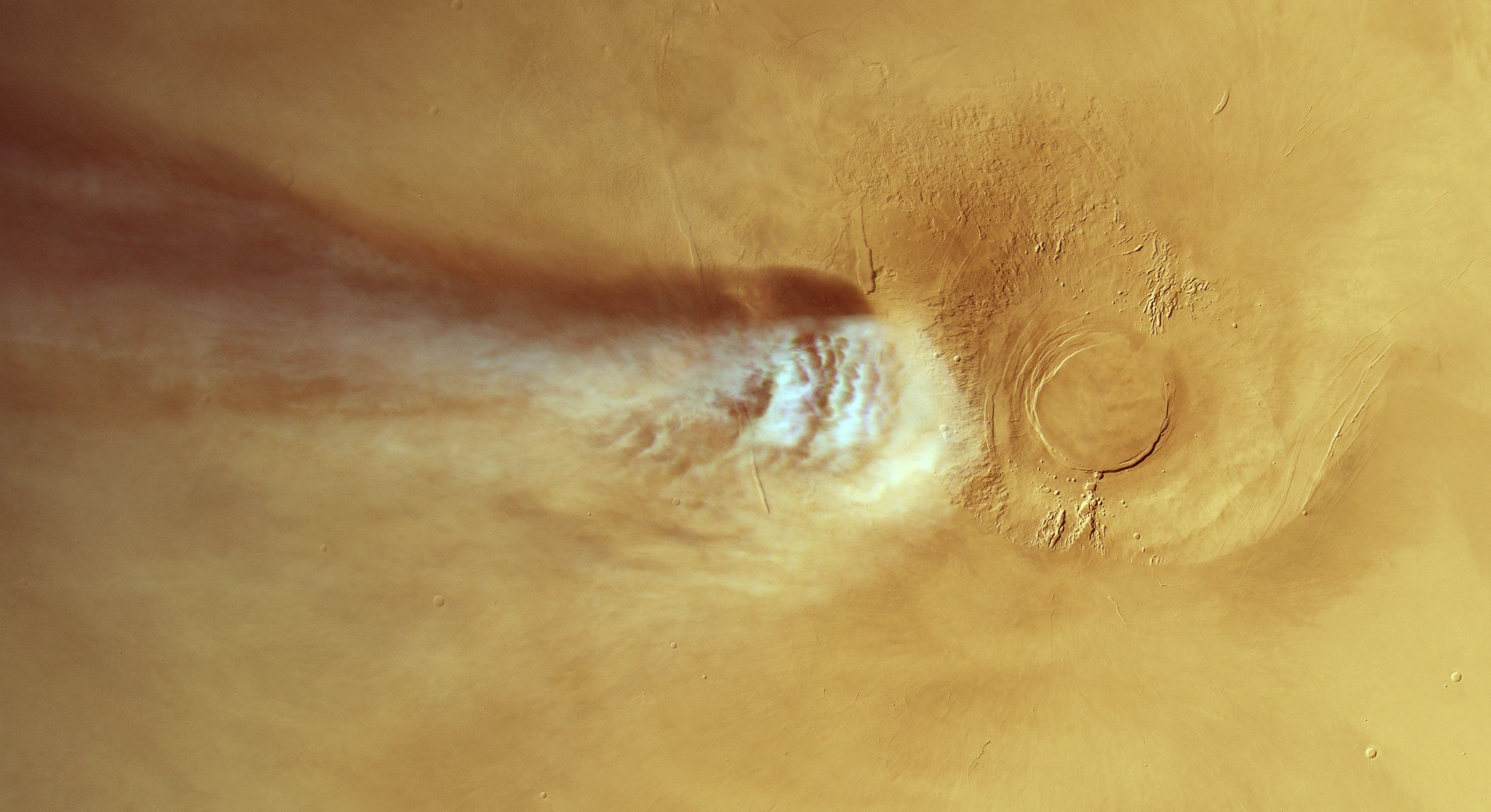
A cloud known as the Arsia Mons Elongated Cloud (AMEC), has baffled scientists since its discovery by a probe in 2018. Recently, researchers have managed to simulate the formation of this cloud for the first time, revealing that it may be caused by a physical process never directly observed in any planet's atmosphere. Lead author Jorge Hernández-Bernal from Paris’ Sorbonne Université stated that the team needed to incorporate "exotic physics," typically considered theoretical and not applicable in nature, to achieve their results.
Typically, Earth clouds form when water vapor creates droplets or ice crystals in the presence of tiny particles. However, the AMEC might be forming via homogeneous nucleation, a process where vapor directly transforms into ice crystals without the need for help from debris. This unconventional method requires extreme conditions, including a sudden temperature drop of 30 degrees Celsius within 10 minutes and high relative humidity.
The Arsia Mons volcano, 65,000 feet tall, is also believed to contribute to the AMEC's formation. When wind currents strike the volcano, they generate a powerful wave that rapidly elevates moist air in the atmosphere.
While scientists have postulated that similar phenomena could occur in other planets' upper atmospheres, including Earth and Venus, they have never been observed until now. The required humidity levels, exceeding 100,000 times the highest value measured on Earth, were previously unknown on Mars. The successful simulation of this cloud's formation, given the extreme conditions needed, is a significant achievement, according to Hernández-Bernal.
This groundbreaking discovery was originally published on WIRED Czech Republic and Slovakia before being translated.
Written by urgent.news from Wired Science's reporting — not their text. Machine-written — may contain errors; check the original before relying on it.