An Evidence-to-State architecture for reliable AI in Retail Pharmacy
Explore the Pharmacy Operational Context Gap and how a proposed architecture can help AI understand the current state of prescriptions.
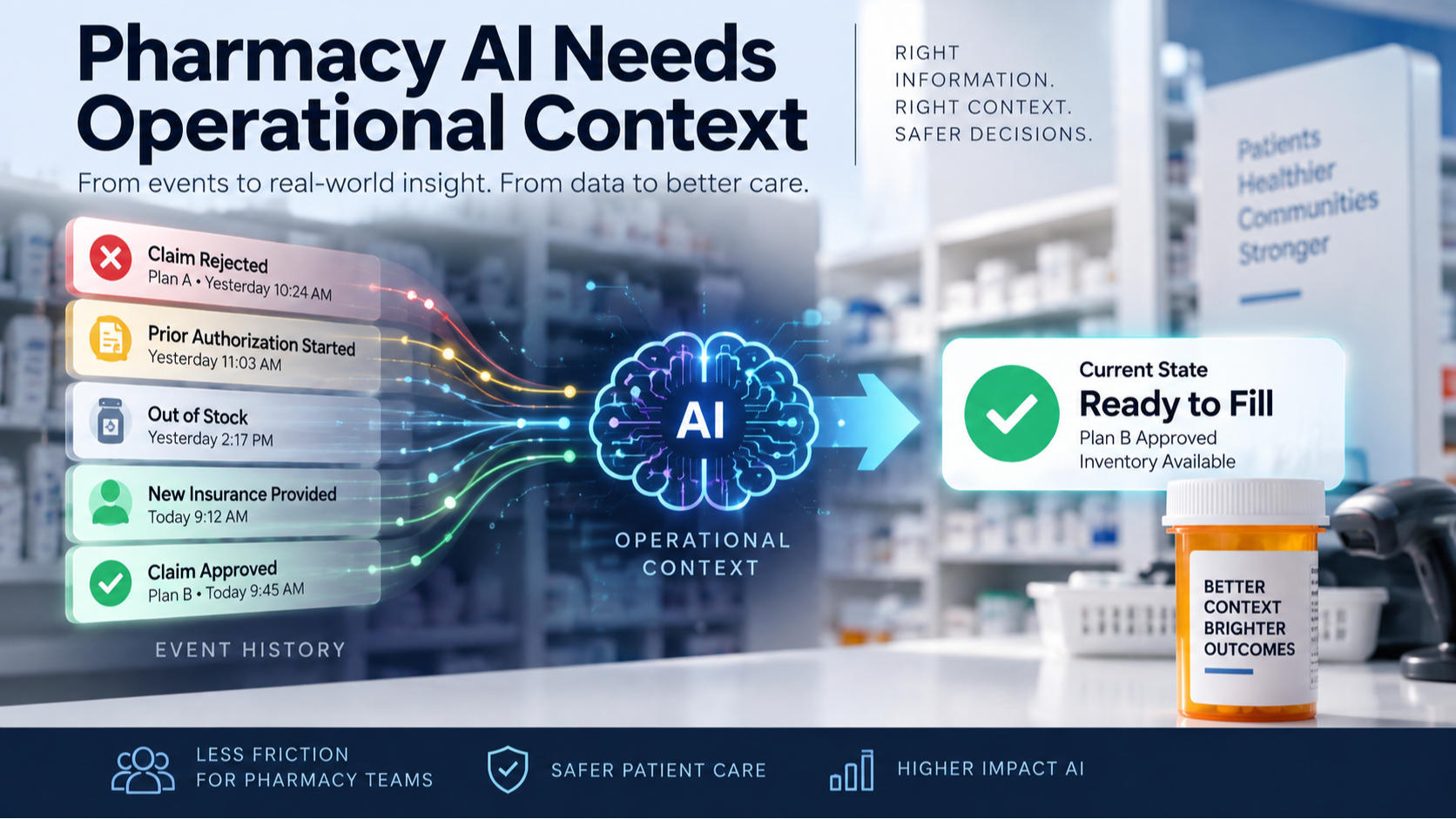
An Evidence-to-State architecture aims to provide reliable AI in retail pharmacy. The challenge lies in translating raw transactional data into a clear operational state for an AI assistant. An AI that only sees the original rejection of a prescription may recommend actions that are no longer relevant, such as resubmitting the claim or contacting the patient.
The goal is to resolve a current prescription context before engaging AI. This projection answers practical questions like what's happening now, what's blocking progression, what's unresolved, who's pending, what evidence supports the interpretation, how fresh the interpretation is, and what action is required next. The proposed solution is a versioned, derived operational context that can be explicitly provided to AI before any reasoning takes place.
The architecture consists of Operational Sources, a Context Engine, a Current Context Projection, and downstream consumers. Operational Sources capture and correlate various evidence about the prescription journey, such as e-prescriptions, claim responses, prior-authorization status, inventory, workflow events, documents, payer portal messages, and staff interactions.
The Context Engine builds relationships among the evidence to resolve operational context over time, taking into account both occurred/effective time and recorded/received time, along with explicit correction and supersession relationships. The Current Context Projection is then made available to downstream systems.
Rewritten by urgent.news; may contain errors — check the original.
Source: hackernoon.com