Urgent.News

What's breaking now, across thousands of outlets.

Tech

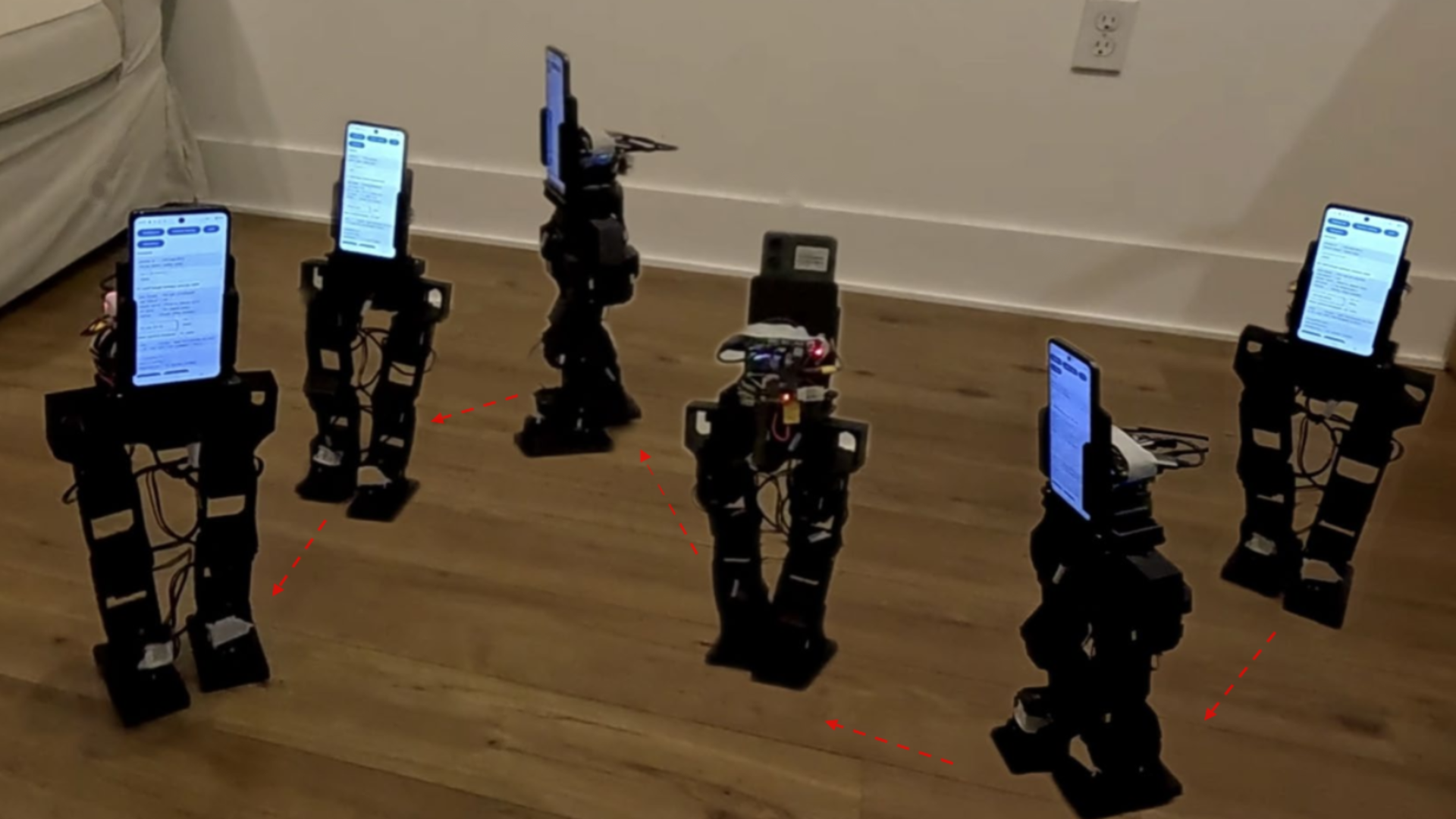
PhoneBot uses an old $50 Android smartphone brain with its cameras as eyes — tech Frankenstein is an open source humanoid robot platform for makers

UCLA researchers developed PhoneBot, a $400 open source humanoid robot using inexpensive Android smartphones for sensing, computing, vision, and walking control.
PhoneBot uses an old $50 Android smartphone brain with its cameras as eyes — tech Frankenstein is an open source humanoid robot platform for makers

A team of researchers at the University of California, Los Angeles (UCLA) has created a compact humanoid robot called PhoneBot using four inexpensive Android smartphones as its core sensing and computing components. The robot costs around $400 to build, excluding the phones themselves, making it significantly more affordable than other small humanoid research systems on the market.

Standing 483 mm tall and weighing 1.8 kg, PhoneBot uses 13 servo motors to control its legs and rotating torso, relying on the built-in hardware of the smartphones for vision, computing, and control instead of dedicated cameras, motion sensors, and an expensive onboard computer. Each smartphone handles specific tasks such as tracking people, motion sensing, visual detection, and communication with the robot through Wi-Fi.

The researchers trained PhoneBot's walking controller using reinforcement learning in simulation, which helped improve its balance and walking patterns without the need for additional simulated physics steps. Although its current walking controller was trained on flat ground and it lacks arms for object manipulation, PhoneBot remains an open-source project, allowing other researchers to reproduce and modify the platform to explore smartphone-based robotics.

Written by urgent.news from TechRadar's reporting — not their text. Machine-written — may contain errors; check the original before relying on it.

This story

This is one outlet's version. Read the fullest account.

Read the original at techradar.com →

More in Tech

Apple Issues Statement on Duo Demand Far Outstripping Supply

The Financial Times: Apple had originally promised delivery of the Duo by October 23, but within hours of orders opening, delivery times through Apple’s website had slipped into late January.

  • Apple unveiled first foldable smartphone, Duo, on September 12
  • Initial delivery date set for October 23, shifted to late January
  • Apple emphasizes extraordinary demand, vows to deliver quickly

Dry-Run Your Asset Pipeline: Validate Covers, Zips And CSVs On A 2 GB Server

Last March I lost a full evening to a header row. I had 60 JPGs ready for Adobe Stock, generated the CSV, uploaded the batch, and every single file came back rejected in under a minute.

  • Author experienced evening-long troubleshooting due to CSV header error
  • Validated all files before uploading to avoid issues
  • Condensed process into four Python scripts to catch failures

How Upload_Tracker.Py Stops Double-Posting When You Re-Run A Batch

I run my whole asset pipeline on a 1 vCPU, 2 GB RAM box with no GPU. A few months ago I had a batch of 40 sticker assets ready for Adobe Stock, Vecteezy, and Dreamstime.

  • UploadTracker.py prevents double-posting in batch uploads.
  • Script maintains ledger of uploaded assets in text file.
  • Ledger updated after successful upload to track unfinished assets.

Part 3 — Networking: From `fetch()` to Packets

Most web developers use HTTP every day. We write fetch() , call APIs, send requests, and handle responses. But lets understand what happens underneath those familiar abstractions.

  • fetch() abstraction hides HTTP, TCP, IP, Ethernet/Wi-Fi layers
  • HTTP uses ports to identify application endpoints (e.g., 443 for HTTPS)
  • DNS resolves domain names to IP addresses for routing packets

More from Sunday 18 October →