Commentary: Could devastating Nepal floods catalyse action at climate talks?
Demands for compensation from climate-vulnerable countries are unlikely to yield outcomes soon, says COP30 special envoy and think tank founder Arunabha Ghosh.
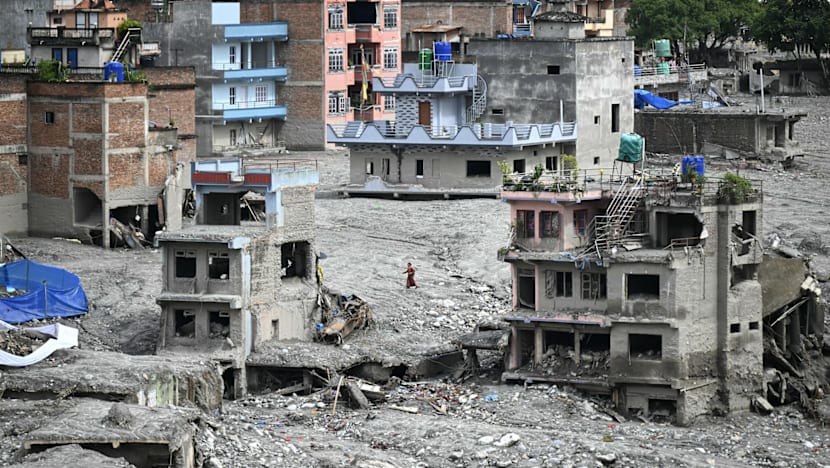
Nepal has been hit by back-to-back devastating floods in August and October, with the latest flash floods destroying homes and infrastructure. The August glacial flood caused US$2.6 billion in property and infrastructure damage, and the reconstruction is estimated to cost US$4.8 billion. Nepal has only requested US$20 million from the United Nations Loss and Damage Fund, which is a mere 0.4 cent of the projected reconstruction costs.
This highlights the country's vulnerability to climate change and the inadequate climate finance available to support recovery and risk reduction efforts.
Developing countries like Nepal face higher freight rates for transporting goods and bear disproportionately higher losses from natural disasters compared to coastal states. The United Nations estimates that least developed countries experience disaster losses equal to about 1 percent of their gross domestic product (GDP), compared to the global average of 0.3 percent of GDP. In some cases, losses can be as high as 226 percent of GDP, such as during Hurricane Maria in 2017 for Dominica.
Despite advancements in attribution science, which links climate change to extreme weather events, demands for compensation from climate-vulnerable countries are unlikely to yield outcomes soon. The International Court of Justice's 2025 ruling that states have binding obligations to prevent significant harm to the climate system is advisory and does not obligate developed countries to provide additional resources.
Developed countries have strongly opposed linking payments for loss and damage to any legal liability for their historical greenhouse gas emissions.
The Loss and Damage Fund, established at COP27 in 2022, has struggled to deliver even a fraction of the pledged funds. As of 2025, only US$585 million has been contributed against the pledged US$822 million, with no project approvals or disbursements. Nepal and other least developed countries and small island states have faced bureaucratic obstacles in accessing funds, and China and India, while eligible to receive funds, are not obligated to contribute as they are classified as developing countries.
Insurance schemes and climate resilient debt clauses have also proven inadequate in providing comprehensive solutions. The Global Shield against Climate Risks launched at COP27 does not fund resilient infrastructure or risk-reduction measures. Climate resilient debt clauses allow postponing pre-existing debt burdens rather than eliminating them. The IMF's Resilience and Sustainability Trust offers longer-term loans on favorable terms but is not a grant or compensation mechanism.
Developing countries may have greater leverage in demanding funds for climate adaptation instead of compensation. A pragmatic route for Nepal and other vulnerable countries would be to focus on building multi-hazard early warning systems and data cooperation in climate-fragile regions. Nepal's prime minister has suggested a Himalayan Climate Resilience Mechanism with India and China, and increased regional trade in clean energy could be a source of revenue and resilience.
Investing in a jobs-intensive green economy in mountainous regions, mangroves, and seaweed cultivation in coastal areas could attract new investment and yield climate co-benefits.
Written by urgent.news from Channel News Asia's reporting — not their text. Machine-written — may contain errors; check the original before relying on it.