Adversarial Testing for Browser E2EE: Authentication, Replay, and State Recovery
Learn how to test browser E2EE against key substitution, ciphertext tampering, replay, downgrade attacks, and asynchronous state failures.
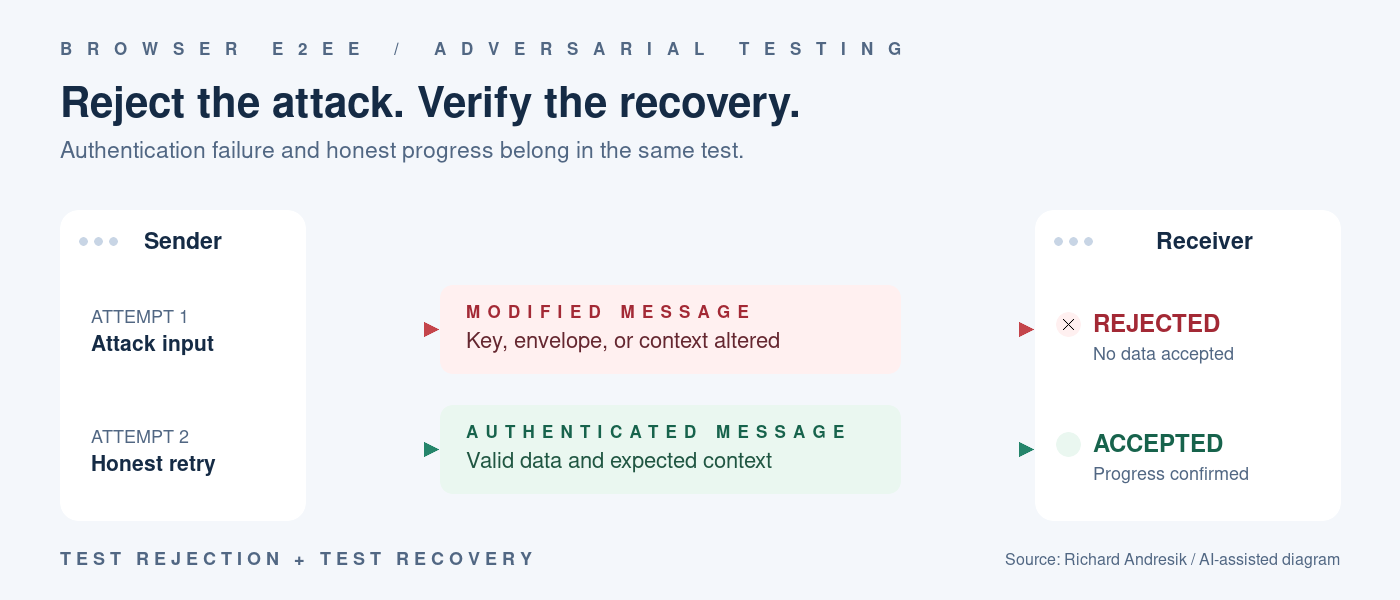
This article discusses the importance of adversarial testing in browser end-to-end encryption (E2EE) packages, specifically for a small browser E2EE package that runs locally with Node.js and no server. It highlights the need for more than just a basic round trip test, as it only detects broken wiring and does not establish that an attacker cannot replace a public key, alter a revision number, replay a file chunk, or leave the session unusable after a rejected message.
The author proposes three different views of the protocol: an honest end-to-end path, adversarial inputs that must fail, and an independent calculation of important cryptographic results. The example provided is the Apache-2.0 IcyZip E2EE review package, which uses P-256 ECDH, HKDF-SHA-256, HMAC-SHA-256, and AES-256-GCM through the Web Cryptography API.
The article also emphasizes the importance of threat boundaries and how metadata can be observed by a relay without being turned into ciphertext, ensuring that leaked pairing links remain harmless. The testing process involves building an oracle that independently calculates the four separate keys derived by the browser module and asserts that all results differ.
Brief written by urgent.news from HackerNoon's own syndicated text. Machine-written — may contain errors; check the original before relying on it.