GhostAction Compromises About 1,900 GitHub Accounts, Targets Over 30,000 Repositories
The credential-theft campaign known as GhostAction has ramped up, targeting more than 30,000 repositories across 3,000 users and organizations. The spike, according to GitGuardian, was observed on October 8 and 9, 2026. "This resulted from compromising the GitHub accounts of about 1,900 users. It attempted to extract 3,174 secrets from public repositories' CI," security researchers Gaetan
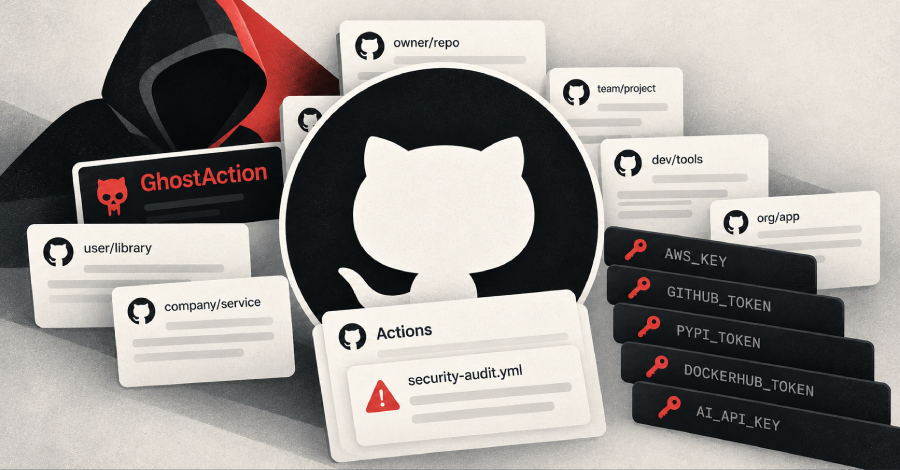
The GhostAction credential-theft campaign has intensified, striking over 30,000 repositories across 3,000 users and organizations. This surge, detected on October 8 and 9, 2026, was the result of taking control of about 1,900 GitHub accounts. The attackers aimed to extract 3,174 secrets from public repositories, according to security researchers Gaetan Ferry and Guillaume Valadon.
GhostAction is a supply chain attack campaign that targets developer infrastructure on GitHub. The scheme was first uncovered in September 2025. It entails threat actors infiltrating legitimate developer accounts to insert malicious GitHub Actions automation workflows into software repositories. By gaining write access to repositories with stolen Personal Access Tokens (PATs) or credentials extracted from logs and dumps, the attackers push a malicious workflow file under deceptive names like Security Audit or GitHub Actions Security.
The main objective of this activity is the widespread theft of continuous integration and continuous deployment (CI/CD) secrets, cloud credentials, package registry tokens, and AI provider API keys. A fresh wave of GhostAction has emerged since August 31, 2026, with the malicious workflow deployed to numerous repositories. This new wave appears to be more experimental and manual compared to earlier ones, with the payload evolving over time.
The updated payload includes a git history secret-scanning feature that detects AWS key IDs, GitHub and GitLab tokens, AI-related secrets, and cloud API keys.
Rewritten by urgent.news; may contain errors — check the original.
Source: thehackernews.com