Could dirty, salty wastewater quench data center thirst?
Data centers need millions of gallons of water a day. Oil and gas industries produce more wastewater than that. Connecting them using today’s desalination technologies makes sense.
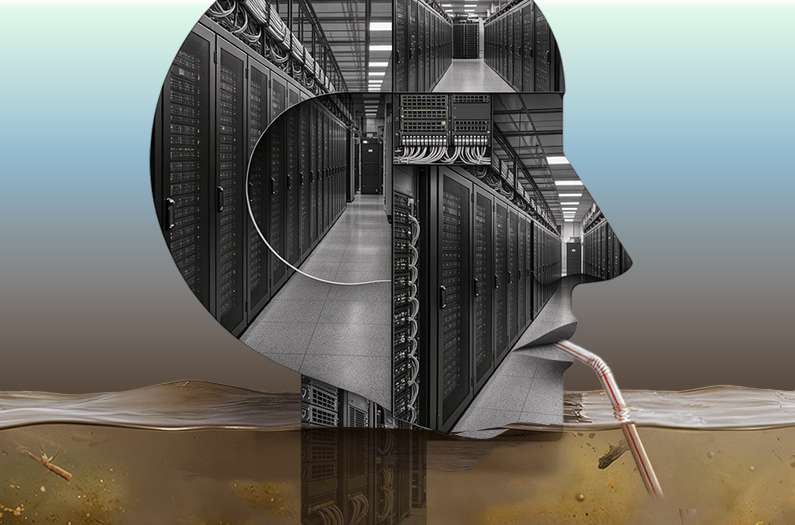
As the 2026 midterm elections approach in the United States, data centers have come under scrutiny for their heavy energy consumption and reliance on freshwater for cooling purposes. Researchers at the University of Texas at Austin propose a solution that could alleviate the strain on local freshwater resources by utilizing wastewater from the oil and gas industry.
In a recent study published in the journal Water Research, mechanical engineering professor Vaibhav Bahadur and his team demonstrate how desalination technologies could be employed to clean up the dirty, salty wastewater produced during oil and gas extraction, rendering it suitable for cooling data centers.
Bahadur emphasizes that while futuristic technologies may eventually address this issue, current desalination methods can already provide an effective solution, albeit at a cost. Data centers, which form the backbone of the modern digital economy, are notoriously energy-intensive, consuming as much electricity as 1,000 US households running a bookshelf-sized computing unit.
Consequently, they generate significant heat, necessitating vast quantities of water for cooling purposes. Daily, data centers can guzzle millions of gallons of water, further exacerbating the pressure on dwindling freshwater supplies.
The Permian Basin in West Texas, a primary hub for oil and gas extraction, generates approximately 8 billion gallons of produced water daily. Traditionally, this wastewater is transported over long distances and injected into underground reservoirs. Bahadur and his team suggest repurposing this waste water for data center cooling, highlighting both the volume and quality of the water as critical factors. Freshwater must contain fewer than 500 parts per million of dissolved solids to be suitable for cooling purposes.
To assess the feasibility of this approach, Bahadur's team modeled the cost and environmental impact of desalination treatments for various saline water sources, ranging from mildly brackish groundwater to the highly saline water produced during oil and gas drilling. They focused on two prominent desalination technologies: reverse osmosis, which employs membranes to block salt and impurities, and heat-driven processes that involve evaporation and condensation to separate clean water from impurities.
The researchers evaluated three data center deployment scenarios, considering factors such as cooling techniques, local saline water conditions, geographic water stress, and brine disposal strategies. The results revealed that a project in Longview, Texas, utilizing brackish groundwater treated through reverse osmosis emerged as the most water-stress efficient option.
Moreover, even the most energy-intensive desalination method consumed a fraction of a data center's total energy demand, indicating that adopting this wastewater utilization strategy would have a minimal impact on the overall energy consumption of data centers.
Written by urgent.news from Anthropocene Magazine's reporting — not their text. Machine-written — may contain errors; check the original before relying on it.