Stratospheric Balloon Telescope Peeks Above The Clouds At The Sun
There’s lots of things you can do with balloons. Children’s birthday parties come to mind, as do retirement parties. But you can also observe the Sun in unprecedented detail with one - or at least with a suite of equipment attached to a gondola floating beneath one. That’s what the SUNRISE III mission did back in 2024, and scientists have had time to compile a series of three scientific papers on…
In 2024, the SUNRISE III mission, led by the National Astronomical Observatory of Japan (NAOJ), utilized a suite of instruments attached to a gondola beneath a helium balloon to gather unprecedented data on the Sun. The balloon soared to an altitude of around 35 km, allowing the instruments to observe the solar atmosphere above most of Earth's turbulent atmosphere. This provided a clearer picture of the Sun's features, such as the smallest magnetic features.
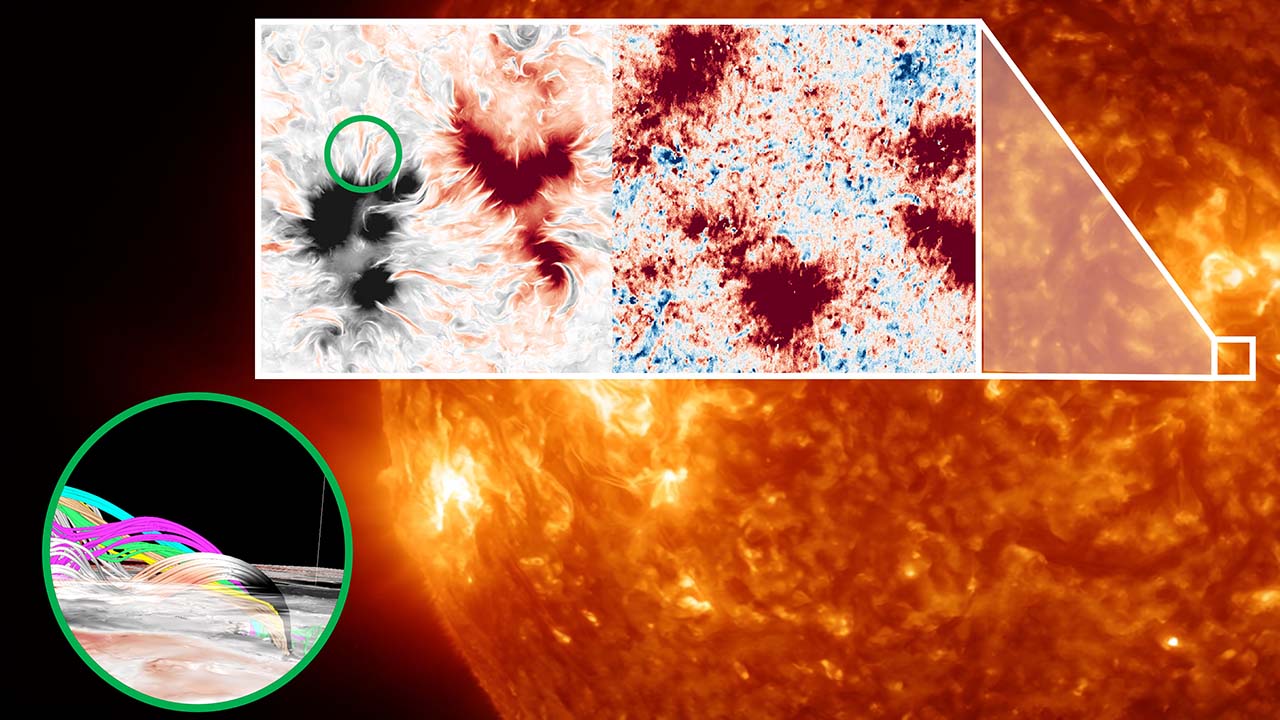
The mission employed the Sunrise Chromospheric Infrared spectroPolarimeter (SCIP) to conduct full Stokes polarimetry of the Sun, enabling scientists to reconstruct magnetic field directions and strengths between multiple atmospheric layers. The researchers discovered that the chromosphere, previously thought to be dominated by vertical magnetic flux tubes, is actually filled with unexpected magnetic threads.
These threads, about 725 km across, exhibit fluctuating magnetic strength between 10 and 20 Gauss and alternate in polarity, creating "opposite-polarity intrusions" (OPI).
Another paper explored these OPIs using a 3D radiative-magnetohydrodynamic simulation algorithm called MURaM-ChE. When SUNRISE III data was inputted into the simulation, the OPI structures matched extremely well, revealing them as twist magnetic flux ropes. Additionally, a third paper examined the magnetic field distribution along spicules, which shoot out from the Sun's poles and are believed to provide energy to the Sun's corona.
The researchers estimated the magnetic field strength to be between 10 and 20 Gauss in the lower canopy, and around 40 Gauss above the solar limb.
Rewritten by urgent.news; may contain errors — check the original.
Source: universetoday.com