French, Japanese scientists share Nobel Prize in Chemistry
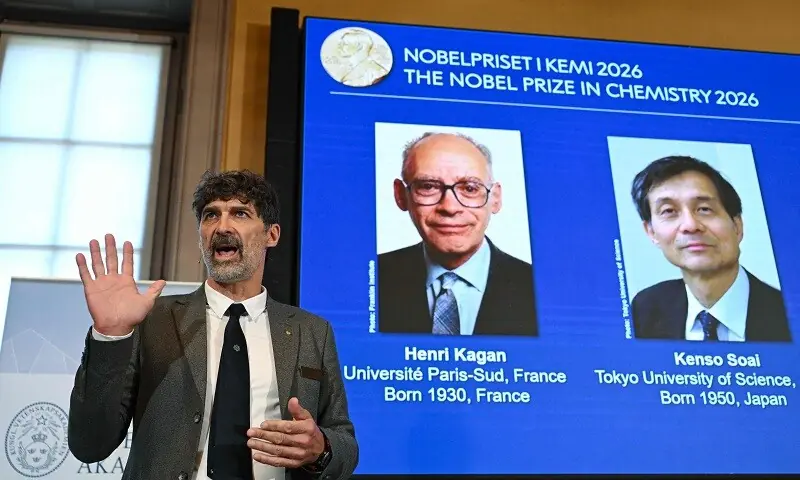
Henri B. Kagan and Kenso Soai won the Nobel Prize in chemistry Wednesday for their discovery of non-linear effects and autocatalysis in asymmetric organic synthesis.

The Nobel Prize in Chemistry has been bestowed upon French chemist Henri B. Kagan and Japanese researcher Kenso Soai for unraveling the enigma of life's asymmetric nature. According to the Nobel Committee, all biological molecules, including amino acids that form proteins, exhibit chirality. This term describes molecules that possess mirror-image versions, only one of which supports the existence of living organisms on Earth.
The reason behind life's preference for one of these mirror-image molecules over the other has been a long-standing question. Kagan and Soai have provided a comprehensive explanation for this phenomenon. In organic chemistry, chirality refers to the existence of two symmetrical forms of a molecule, each with distinct properties.
To illustrate, these forms can be likened to human hands, which are mirror images of each other. In the pharmaceutical industry, this distinction is of utmost importance. One version of a molecule may possess disease-fighting properties, while its counterpart is ineffective. Kagan and Soai have devised methods to engineer chemical reactions that yield a significantly higher proportion of the desired, beneficial version.
Written by urgent.news from BBC News's reporting — not their text. Machine-written — may contain errors; check the original before relying on it.
This story
This is one outlet's version. Read the fullest account.
- Sleep, appetite, gene-editing experts contend for Nobel chemistry prize malaymail.com
- Chemistry Nobel awarded for solving mystery of life's asymmetry bbc.co.uk
- Nobel prize in chemistry awarded for work on mirror-image molecules theguardian.com
- French, Japanese scientists share Nobel Prize in Chemistry cbc.ca
- Nobel Prize in chemistry awarded to Kagan and Soai for developing 'spectacular' chemical reactions phys.org
- Chemistry Nobel 2026 awarded to Henri B. Kagan and Kenso Soai thehindu.com