Autotest: Auf zu großem Fuß – so fährt sich der Opel mit Rallye-Genen
Opel will mit dem Kürzel GSE wieder sportlicher werden. Den Auftakt macht der Mokka. Mit Sport-Update soll das Modell echtes Rallyegefühl bieten. Doch das hat seinen Preis.
Opel, the Stellantis subsidiary, aims to preserve its sporty heritage in the electric vehicle era. Although Rüsselsheim may not readily come to mind when mentioning a motorsport brand, Opel boasts a successful rally history. In 1982, Walter Röhrl took the World Championship title with the Ascona 400. For their sporty models, Opel uses the acronym GSE – Grand Sport Electric.
This acronym has a rich history, dating back to the 1960s when Opel built the Commodore A GS/E with a powerful engine. GS stood for Grand Sport, and E stood for Injection back then. The cars were initially marketed as affordable sport cars for the middle class, offering performance at a bargain price. The E was replaced by I in the Opel history, as Injection in English translates to Injection and eventually the OPC models became the strongest in the lineup.
Today, the E is back, but this time it stands for Electric. Several electric models are planned, and the test vehicle for this week was the Mokka GSE. Choosing the compact SUV as the pioneer for the sport update was surprising. As a base, it is rather a sensible decision, being the entry-level gasoline car for €27,390. The GSE-version, however, costs a minimum of €47,800.
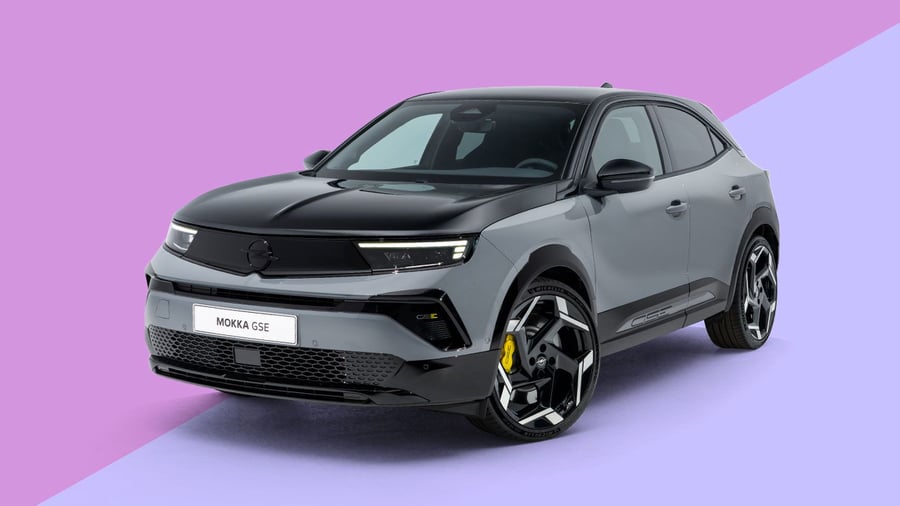
With a black hood and silver paint, it costs nearly €49,000. Compared to the previous top model Mokka Electric GS with 156 PS, which costs around €39,000, it's almost €8,000 more. For a brand that once aimed at offering performance affordably, it's quite a lot. One striking feature is that the Mokka GSE stands on large feet, specifically 20-inch black and silver alloy wheels with Michelin Sport tires (225/40 R20).
These tires seem oversized on the relatively compact car, as if it's standing on stilts. Optically, the Mokka GSE adopts the look of the rally model: the yellow brake calipers on the front axle are exclusive to the GSE variant, making it recognizable from a distance. If that's not enough, the model also carries quotes from the racing variant: the hood is black, so are the side skirts, and the front has been redesigned to look more dynamic.
Full-LED lights with adaptive headlights are standard and come in the same glare-inducing style as the car's emblem. The power comes down to the road via the black Opel logo hidden on a black background, which exudes confidence. The Mokka GSE inherits the motor, inverter, battery, and wiring from the rally model, and the top performance of 207 kW (281 PS) is identical to the motorsport variant.
Acceleration from 0 to 100 in 5.9 seconds is fixed for an electric car, but it's not thrilling. The engineers had to overcome a small challenge, as a front-wheel drive makes it difficult to cleanly transfer power to the road. Nonetheless, 345 Nm is readily available at the wheels. The Opel engineers solved this issue with a mechanical Torsen-layshaft limited-slip differential at the front axle, also from the rally sport.
This aims to optimally distribute torque to the front wheels, preventing a wheel from spinning when accelerating around a corner. It works well in practice, except for occasional sliding on wet roads. Otherwise, the Mokka GSE remains grounded on asphalt. The steering is direct and precise, making the power easy to handle. Assists like an adaptive cruise control or a lane-keeping assistant are present, but driving the car manually is still enjoyable.
The bodywork has less body roll than the regular Mokka thanks to new Hydro-Suspension dampers. Overall, the Mokka GSE is finely tuned but puts a lot of strain on its driver, which might explain the high price. High consumption on the highway is a concern, given the car's lightweight 1672 kg and the 339 kg battery. The 54 kWh under the hood is supposed to provide up to 336 kilometers of range.
However, the value is often below average, mainly due to high consumption. At highway speeds, the speed limiter kicks in, and the recharging system is completely turned off, leading to poor consumption beyond good and bad. In everyday use, the recharging system and shift paddles are absent, which could have helped control the speed.
For long distances, the Mokka is not very suitable. The Alcantara sports seats with yellow-white stitching offer a visually appealing and comfortable experience during curves. Modern amenities like a multi-stage seat heating system add to the comfort.
Written by urgent.news from Handelsblatt's reporting — not their text. Machine-written — may contain errors; check the original before relying on it.
This story
This is one outlet's version. Read the fullest account.