NASA’s Eyes software: September release notes
On September 30, 2026, a new version of Eyes on Asteroids was released. This release added a new “Impact” tab on the asteroid information panel, as well as a “Watch” button to see the impact at the time it happened. In addition, for any of the 42,580 Near-Earth Objects (NEOs), there is now a “Watch” […] The post NASA’s Eyes software: September release notes appeared first on NASA Science .
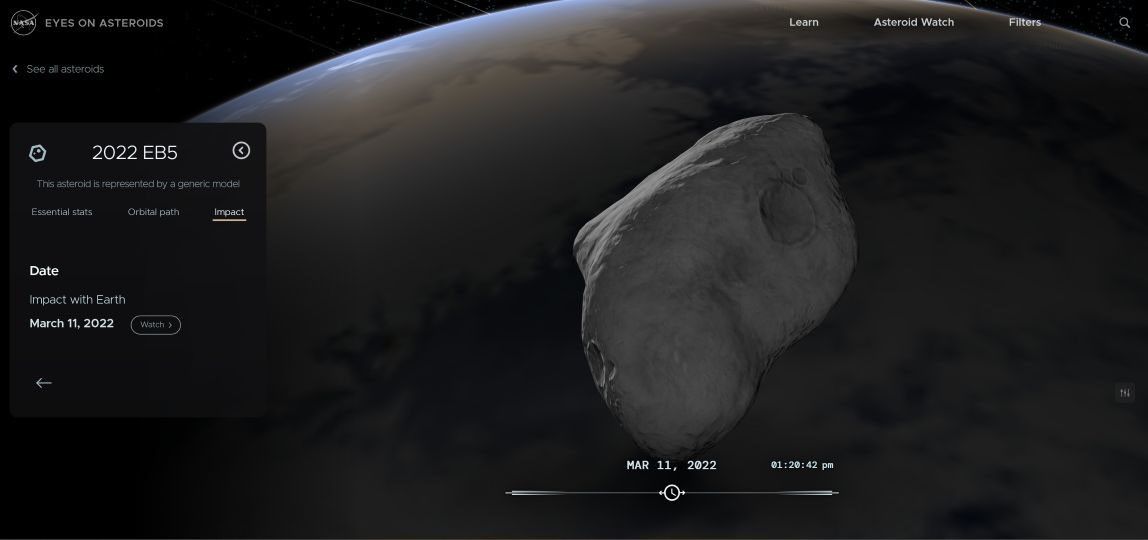
On September 30, 2026, NASA launched an updated version of its Eyes on Asteroids software. This release introduced several new features to enhance the visualization of Near-Earth Objects (NEOs).
One of the key additions is a new "Impact" tab on the asteroid information panel. This tab allows users to view potential impact scenarios for NEOs. Additionally, there is a "Watch" button that enables users to observe the impact at the time it would have occurred.
For all 42,580 Near-Earth Objects tracked by NASA, a "Watch" button is now available to visualize the closest approach to Earth. However, this feature is only activated if the asteroid comes within 0.05 Astronomical Units. For context, an Astronomical Unit is the average distance between the Earth and the Sun, approximately 93 million miles (150 million kilometers).
The "Watch" button provides users with a way to see the closest approach of an asteroid in a three-dimensional environment. It's important to note that the software's time range only extends ten years into the future to maintain high levels of accuracy. Therefore, any close approaches occurring more than ten years away are not displayed in 3D.
Furthermore, any asteroid that has impacted Earth in the past has an "Impact" tab in its information panel. This tab allows users to view the actual incident. Similarly, there is a "Watch" button for these past events to see the actual occurrence.
The update also includes an expanded "Learn" section titled "How NASA Protects Earth." This section now features a new slide that highlights NEO Surveyor, a mission set to launch in 2027. NEO Surveyor's primary objective is to specifically detect darker asteroids, which are typically more challenging to spot.
Written by urgent.news from NASA Science's reporting — not their text. Machine-written — may contain errors; check the original before relying on it.