Hofstadter’s butterfly turns 50: a fractal hiding in quantum matter
Indu Satija celebrates the golden anniversary of Hofstadter’s butterfly The post Hofstadter’s butterfly turns 50: a fractal hiding in quantum matter appeared first on Physics World .
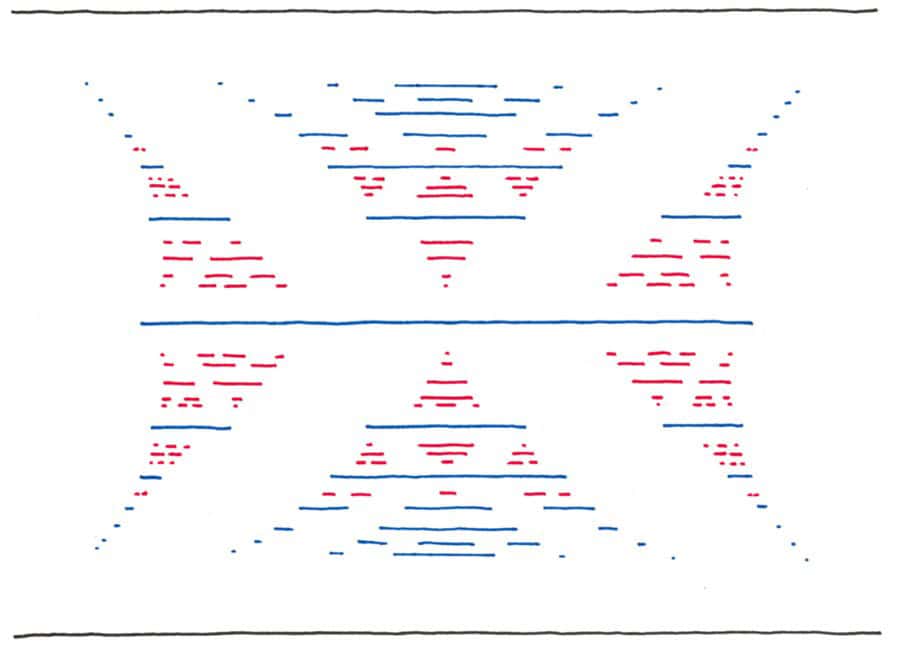
In the mid-1970s, Douglas Hofstadter, a graduate student at the University of Oregon, encountered a perplexing quantum conundrum while attempting to solve Harper's equation. This equation described the behavior of electrons in a two-dimensional crystal lattice subjected to a perpendicular magnetic field. As Hofstadter grappled with the problem, he discovered a mesmerizing pattern emerging from the electron motion – a seemingly intricate structure composed of infinitely nested bands and gaps.
This striking pattern, known as Hofstadter's butterfly, was first published in Phys. Rev. B in 1976. Despite initial skepticism and dismissal by his advisor, Wannier, Hofstadter's discovery gained recognition when Wannier acknowledged its significance and awarded him his PhD. Over the following five decades, Hofstadter's butterfly has become increasingly significant, reappearing in new materials, experiments, and even in the realm of black holes.
Researchers like Kazuki Ikeda and Yaron Oz have suggested that similar patterns may manifest in the physics of black holes, further emphasizing the intriguing connection between this fractal structure and the quantum world. This discovery, born from a simple model, has come to symbolize the emergence of complexity from fundamental rules, the beauty that arises from constraints, and the unexpected surprises still hidden within the quantum realm.
Written by urgent.news from Physics World's reporting — not their text. Machine-written — may contain errors; check the original before relying on it.