China develops plant to extract hydrogen, fresh water and uranium from the sea
Chinese scientists have built a small, stable co-production plant that uses one system to extract hydrogen and fresh water from seawater, while also recovering uranium and bromine and improving electricity use efficiency by about 15 per cent. The team, led by Deng Dehui and Liu Yanting from the Chinese Academy of Sciences’ Dalian Institute of Chemical Physics, improved on an existing technology…
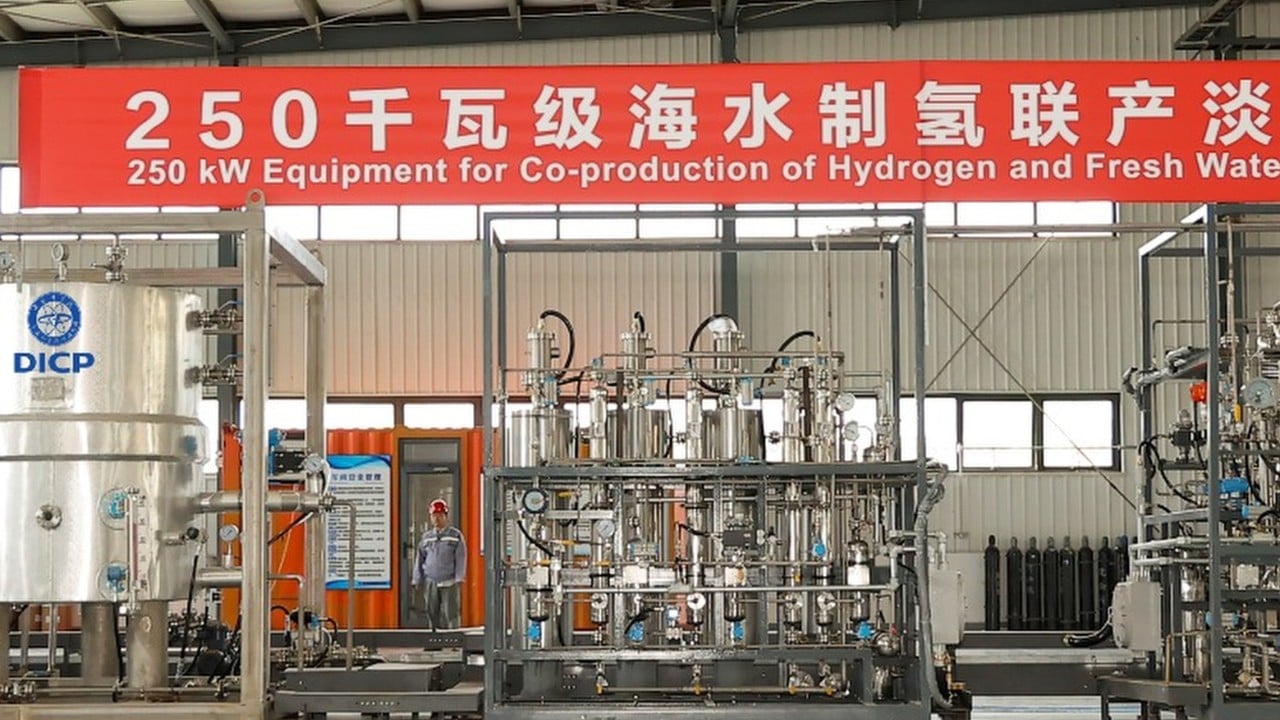
Chinese scientists have developed a compact, efficient plant that simultaneously extracts hydrogen, fresh water, and uranium from seawater, while also improving overall energy efficiency by around 15 percent. Led by Deng Dehui and Liu Yanting from the Chinese Academy of Sciences’ Dalian Institute of Chemical Physics, the researchers built upon an existing technology that had proven costly and energy-intensive.
The new approach tackles issues faced by direct seawater electrolysis and the two-step desalination-electrolysis method, both of which have drawbacks.
Previously, the Chinese team constructed a 25-kilowatt unit based on desalination technology, which was rated as internationally leading by the China Petroleum and Chemical Industry Federation in 2023. They then scaled up the design, creating a 250-kilowatt plant, with a focus on addressing a previously overlooked power leak. By linking the electrolyte with a desalination unit and transferring waste heat from electrolysis to a vacuum distillation tower, the researchers found they could recover salt, uranium, bromine, and other marine resources from the remaining concentrated seawater in multiple stages.
The 250kW unit can generate 380,000 standard cubic meters of hydrogen annually, reaching a purity of 99.9999 percent, as well as producing 256 tonnes of fresh water. Compared to traditional alkaline water electrolysis for hydrogen production, the system enhanced electricity utilization by 14.4 percent. The study found that the system holds significant potential for cost-effective hydrogen production, with an estimated average cost of US$2.1 per kilogram when electricity costs are US$0.033 per kilowatt-hour from onshore wind or US$2.9 per kilogram from solar power.
Currently, hydrogen sells for around US$3.9 per kilogram. Future research should concentrate on developing better catalysts, improving waste heat recovery, and utilizing artificial intelligence to optimize process parameters.
Written by urgent.news from Reuters Business via SCMP's reporting — not their text. Machine-written — may contain errors; check the original before relying on it.
This story
This is one outlet's version. Read the fullest account.