Astronomers catch a star slowly snacking on a brown dwarf, 300 light years away
The discovery reveals a new way that stars and planetary companions can interact.
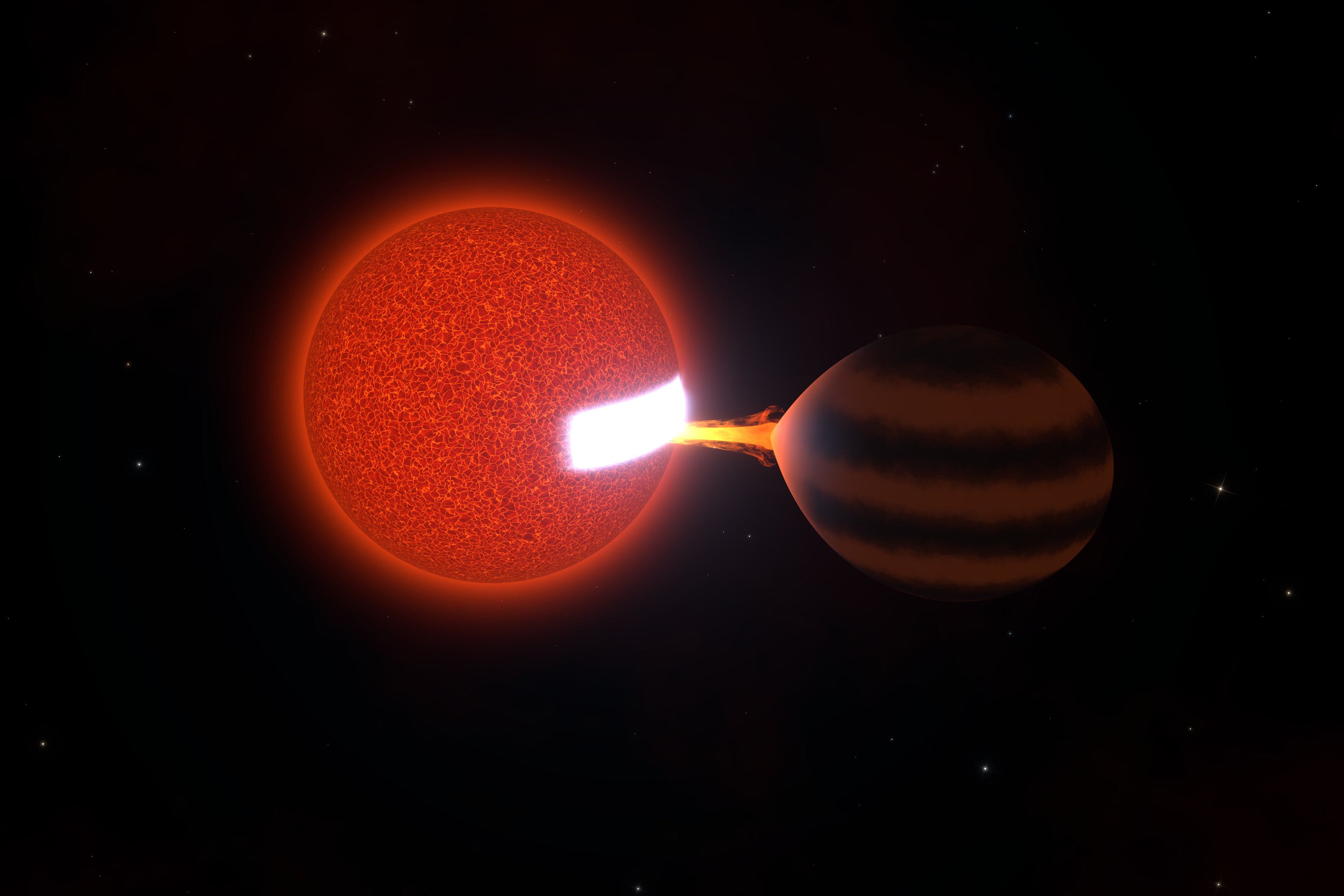
Astronomers have discovered a star gradually consuming a brown dwarf that orbits it, located 300 light years away from Earth within the Milky Way galaxy. This close encounter between the star and the brown dwarf represents a unique case of low-mass objects engaging in a slow, steady form of stellar cannibalism, as opposed to the common scenario of a star eventually swallowing a planet or brown dwarf.
The system, designated as ZTF J0440+2325, was initially detected by the Zwicky Transient Facility, which scans the sky for rapid changes in brightness that could signal the presence of cosmic events like supernovae or colliding neutron stars. However, the light curve observed for this system did not resemble a bell curve typical of a supernova but rather a triangular pattern that persisted over time.
Initially, researchers thought the signal might be a "black widow binary," where a dense, spinning neutron star consumes a smaller companion star. However, the observations revealed a much smaller wobble than typical for such systems, indicating that the interaction was more balanced. Further analysis using multiple telescopes confirmed that the star and the brown dwarf were extremely close, with the brown dwarf orbiting the star every 87 minutes in an orbit smaller than the sun's diameter.
Both objects are relatively small, with the star approximately 85 times as massive as Jupiter and the brown dwarf around 25 times as massive. The team conducted simulations of possible accretion processes in the system and found that the properties of the star and the brown dwarf supported the idea of material being drawn directly onto the star's surface at high speeds, similar to an asteroid impact.
This slow and steady form of stellar cannibalism could continue for hundreds of thousands, or even billions of years, offering a new insight into how stars can interact with their planetary companions.
Written by urgent.news from MIT News Research's reporting — not their text. Machine-written — may contain errors; check the original before relying on it.
Also reported by 1 other outlet
- Astronomers catch dwarf stars gobbling up their orbiting companions scientificamerican.com