China's express delivery industry shifts toward higher-quality growth
With profitability consistently outpacing volume expansion, the sector's traditional strategy of sacrificing margins for market share is giving way to a more sustainable model.
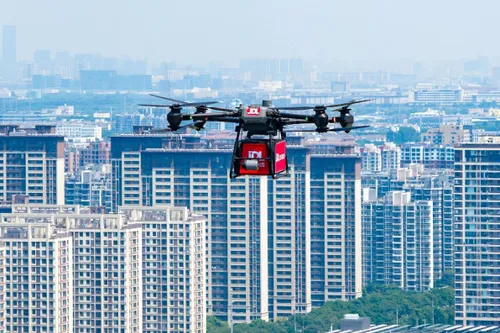
China's express delivery industry is undergoing a significant transformation, shifting from a focus on sheer volume to a more strategic approach emphasizing quality and efficiency. During the first half of 2026, the industry processed 100 billion parcels, marking a 5% increase year-on-year, while revenue surged to 770 billion yuan, a 7.3% rise. Notably, revenue growth outpaced parcel volume growth for the first time, indicating a structural shift in the market.
Major players in the industry, including SF Express, YTO Express, Yunda Express, and STO Express, have demonstrated impressive profit growth, with some exceeding 70% during the same period. This trend suggests a move away from the traditional strategy of sacrificing margins for market share towards a more sustainable model based on operational efficiency and value-driven growth.
Technological innovation is driving this shift. JD Logistics, under JD.com, has deployed the largest rural drone delivery network in Zizhong county, Sichuan province, serving 131 administrative villages with delivery times as short as seven minutes. Guangzhou's Jianggao mail processing center collaborates with humanoid robots, sorting packages at a rate of 800 units per hour.
The industry's profit surge in the first half of 2026 is partly attributed to the maturation of digital infrastructure investments made in previous years. AI is increasingly integrated across the logistics chain, with companies like YTO Express and ZTO Express leveraging AI-driven routing platforms and autonomous delivery vehicles to optimize delivery paths and cut labor expenses.
Fleet automation is also scaling rapidly. Yunda Express has over 1,500 autonomous delivery vehicles, a 1,000 increase from last year, leading to a 30% reduction in transport costs at local distribution hubs. Nationwide, the industry now operates more than 16,000 autonomous delivery vehicles and over 400 drones for last-mile logistics.
Looking ahead, the sector aims to integrate frontier technologies and cultivate new engines of economic growth during the 15th Five-Year Plan period (2026-2030). Major couriers are diversifying revenue streams beyond e-commerce-driven volume surges, focusing on tailored supply chain solutions, specialized logistics offerings, and high-value niche services.
By targeting these unmet consumer demands, companies like JD Logistics and SF Express are establishing a new growth curve, signaling a promising future for China's express delivery industry.
Written by urgent.news from IOL's reporting — not their text. Machine-written — may contain errors; check the original before relying on it.