The First Female Pharaoh? An Old Photo of Ancient Hieroglyphics Highlights the Status of One of Egypt’s Earliest Queens, Researchers Say
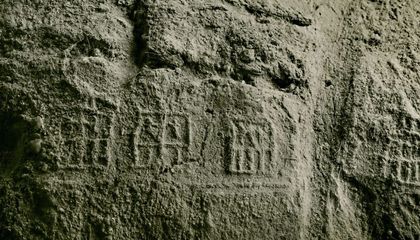
The black-and-white photograph of a long-lost artifact depicts four serekhs, symbols of Egyptian rulers, and two of them, a recent study suggests, are hers
In a recent study published in Prague Egyptological Studies, researchers claim to have discovered evidence that a woman named Meretneith may have been one of the earliest queens in ancient Egypt, potentially ruling alongside or even as king. Meretneith lived during the first dynasty of Egypt, around 2800 BCE, and was likely related to King Djer.
While historians have long recognized her significance as an important royal figure, with a vast burial complex containing 41 servants and courtiers and sealed jars of wine, it has been unclear whether she was an independent ruler or simply a regent.
The key piece of evidence supporting Meretneith's potential as a female pharaoh comes from an ancient hieroglyphic inscription found on a mud stopper. These stoppers were used to seal jars and were inscribed with special glyphs called serekhs, which represent Egyptian rulers. In 1944, English archaeologist Walter B. Emery discovered 13 of these stoppers at a tomb in Saqqara, where he identified Meretneith as the ruler represented by the second and third serekhs.
However, due to the poor quality of the original published photo, the validity of Emery's claim was called into question.
Researchers Susan Kelly and Crystal Miller re-examined the old photograph using digital tools, producing a crisp digital replica of the hieroglyphs. Their analysis shows that the symbols on the serekhs are consistent with Meretneith's patron deity and name, suggesting that the glyphs truly belong to her. This finding challenges the consensus among Egyptologists that Meretneith was merely an interim ruler or regent, as she appears to have held the primary mark of rulership, an attribute exclusively held by male kings during this period.
Written by urgent.news from Smithsonian's reporting — not their text. Machine-written — may contain errors; check the original before relying on it.