Klima: Negative Pegelwerte - Rekordniedrigwasser des Rheins
Die schlagzeilenträchtigen Niedrigwasserstände der verkehrsreichsten Wasserstraße Europas im August sind noch weiter gesunken. Welche Folgen hat das für Schifffahrt und Natur?
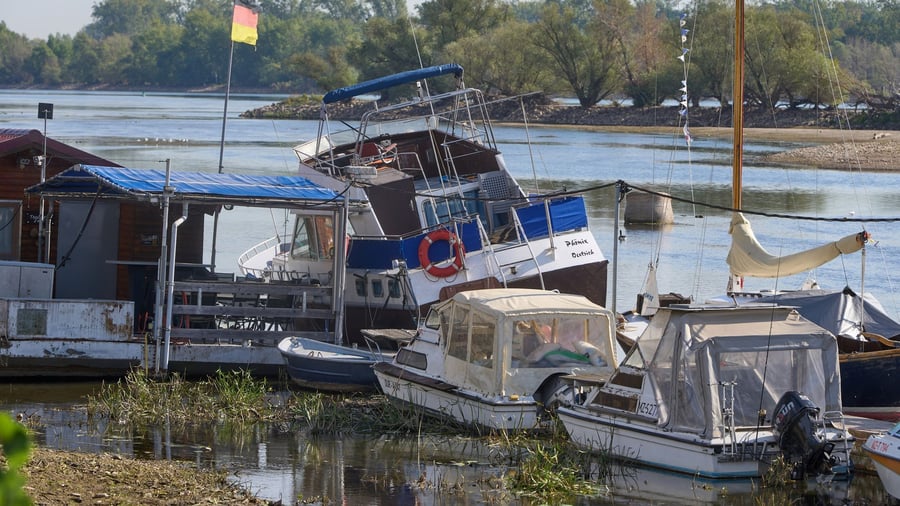
In August, the Rhine experienced record low water levels, causing headlines around the world. However, the situation has become even more dire as the water levels have recently dipped slightly below zero at the Kaub measurement point in Rhineland-Palatinate, which is particularly important for inland waterway ships. The responsible authority predicts only slightly positive centimeter values in the coming days, but only in the single-digit range.
River levels near the shore do not indicate the actual water depth, but rather the water level at a fixed measurement point, as the Rhine is deeper in the Rhine bend. The same applies to Cologne, where a record low water level was recorded on Monday. Experts explain that on August 5, 2026, the historically lowest measured water level, 25 centimeters in 2018, was broken for the first time in Kaub.
"Since then, we've been dealing with such low water levels," the expert adds. At the moment, there is little rain in sight to raise the Rhine level significantly. "We would actually need continuous rain for two weeks, especially in southwestern Germany," says Jens Schwanen, Managing Director of the German Inland Waterways Association (BDB) in Duisburg.
In Cologne, the Federal Institute of Hydrology and the Waterways and Shipping Administration forecast only minimal movement in the coming days. The situation is expected to improve by September and October, which are traditionally the low-water months. Inland waterway ships are currently only able to navigate sporadically on the central Rhine stretch between St. Goar and Mainz.
In the large Rhine basin, there is a lack of sufficient rain. "The inland waterway industry is still providing service to its customers, but can only transport reduced loads," explains Fabian Spieß, Deputy Managing Director of the BDB. The inland waterway industry continues its operations as long as it is safe to do so. Florian Krekel of the Waterways and Shipping Office in Bingen adds that most ships could navigate the narrowest section of the Rhine between St. Goar and Rüdesheim with water levels of only 1.50 or even 1.20 meters.
The Rhine is effectively divided into two parts, excluding less specialized ships that can still pass through with heavily reduced loads. Major sectors, such as mass goods, chemicals, and steel production, have been significantly disrupted. For instance, the BASF plant in Ludwigshafen relies on about half of its raw materials being transported by inland waterways.
The consequences for consumers are not immediate, as they can easily be rerouted. However, essential resources like diesel fuel are transported by inland waterways, but the situation in the Rhine region has not been fully resolved, and there are no drastic increases at the pump. The German Inland Waterways Association is calling for a 20-centimeter deepening of the river bend between St. Goar and Mainz.
This project has been ongoing for many years. Additionally, the federal transportation ministry should investigate measures to ensure a more permanent water supply in the river system. Inland waterways specialist Beatrice Claus of the WWF notes that the effects of the climate crisis are becoming increasingly evident, as evidenced by the recurring records of record low water levels on the Rhine.
To prevent such low water levels, forests, wetlands, and riparian vegetation should be preserved, as they serve as natural water reservoirs and can supply rivers with water even during dry periods.
Written by urgent.news from Handelsblatt's reporting — not their text. Machine-written — may contain errors; check the original before relying on it.