America is planning more AI datacenters than its chip supply can fill
Satellite imagery shows construction accelerating, but advanced packaging could cap 2027 deployment in the low 20s of gigawatts
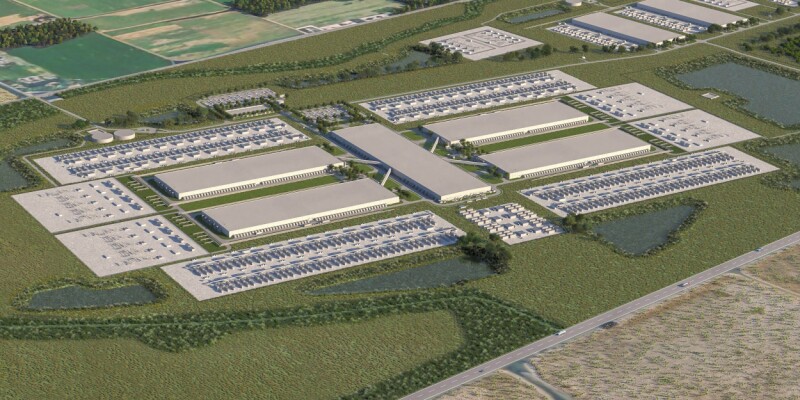
The US is constructing more artificial intelligence datacenters than its existing chip supply can support, according to satellite imagery and reports. However, permitting, access to power, and shortages of packaged AI accelerators are slowing down the deployment process. Advanced packaging, the process of combining multiple accelerator dies and memory components, is also emerging as a constraint.
Research by investment bank Jefferies indicates that server farm construction is proceeding rapidly across America, but factors like permitting, power access, and AI accelerator supplies are hindering progress. SynMax, a business analytics firm, estimates that US datacenter deployments will increase from around 11 GW in 2025 to 16-18 GW in 2026, with a practical upper limit of low 20s GW by 2027.
However, satellite data reveals that the rate of land clearing for new projects has reached a plateau, which is not fast enough to meet the anticipated capacity demands. Only half of the US capacity scheduled for 2026 is currently under construction, and up to 80 percent of the 2028 pipeline has not yet begun work. Advanced packaging of AI accelerators in the US might be limited to roughly 13 GW of gross power, with a total datacenter power capacity of around 17.5 GW.
Jefferies reported that the US market could require 90 percent of global AI chip growth to be met between 2025 and 2030, with Texas and Virginia being the primary states for development. Obtaining uninterrupted grid service can be challenging in Texas, requiring datacenters to potentially reduce power draw when instructed. The economics of datacenter operations could be jeopardized by unpredictable grid curtailments lasting only a few minutes, as highlighted by Jesse Gossett, a former developer and participant in the Electric Reliability Council of Texas (ERCOT) large-load working group.
Written by urgent.news from The Register's reporting — not their text. Machine-written — may contain errors; check the original before relying on it.
This story
This is one outlet's version. Read the fullest account.