A New Test Looks For A Subtle Twist In Ancient Light
The standard model of cosmology predicts that the Universe is homogeneous. A new study tests this using the polarization of the cosmic microwave background and finds this isn't quite true. This study supports an earlier study which also found a small polarization bias.
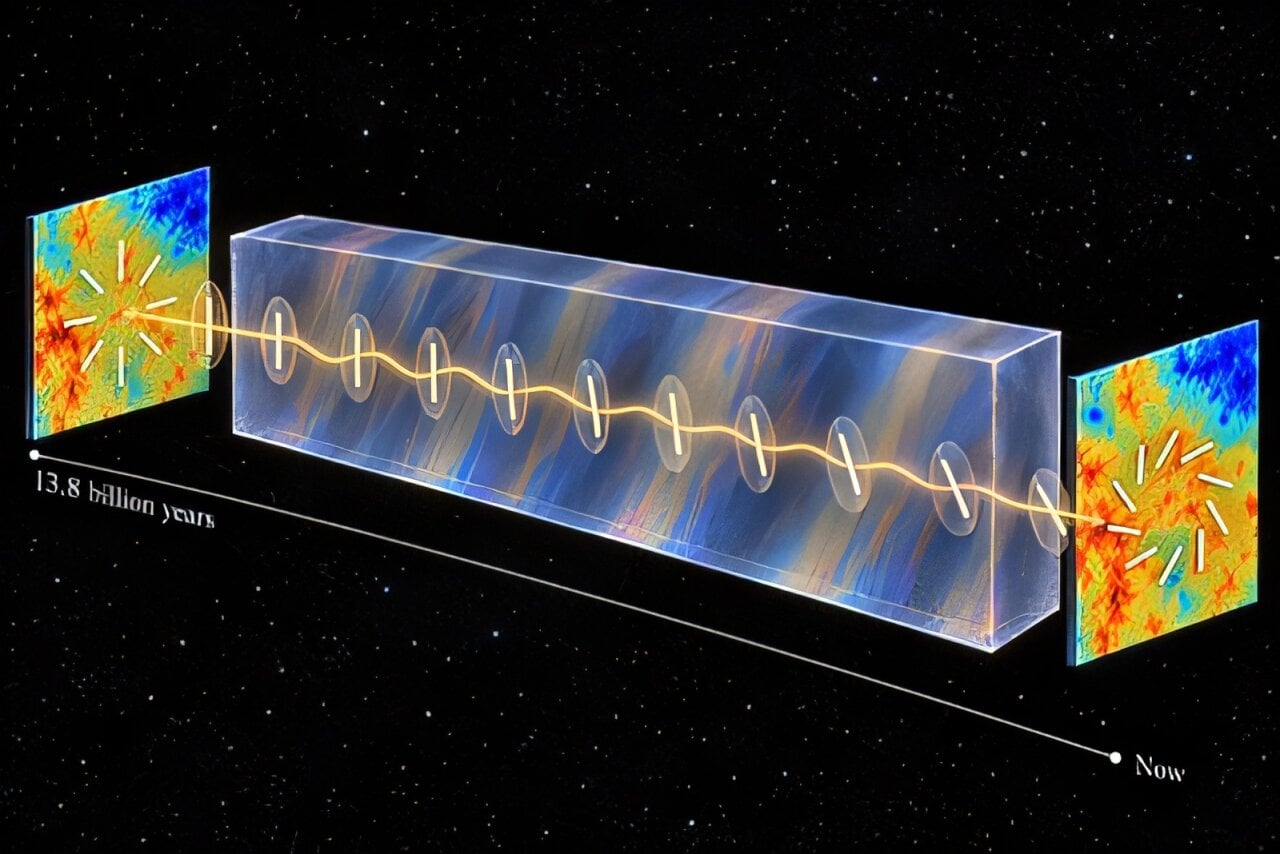
Ancient light known as the cosmic microwave background (CMB) has been traveling for over 13 billion years to reach us, carrying valuable information about the early Universe. One such piece of information is polarization, which was encoded when the Universe became transparent around 380,000 years after the Big Bang. Initially, CMB photons were polarized randomly, but over billions of years, various factors have influenced their orientation. Two primary types of polarization are E-mode and B-mode, each having distinct origins.
E-mode polarization arises from temperature variations in the CMB and was first observed in 2002 by the DASI interferometer. It aligns with the temperature fluctuations seen by the Planck spacecraft, providing further evidence for the Big Bang theory. On the other hand, B-mode polarization, which was detected in 2014, can result from two sources: gravitational lensing or early cosmic inflation.
However, the presence of a global shifting of cosmic light, or cosmic birefringence, contradicts the standard model of cosmology. This phenomenon is expected to be absent, yet a study in 2020 found a non-zero value, suggesting that the standard model might be incorrect or incomplete.
To address the uncertainty surrounding cosmic birefringence, a new study proposes a method to test for observational bias. By comparing the shifts in observational sets, the researchers found that the small polarization shift discovered in 2020 appears to be cosmic in origin. This result lends support to the notion that our basic assumptions about the cosmos might be incorrect, indicating that the Universe may not be as homogeneous as previously thought, or there could be a dark matter particle influencing the cosmic polarization. Further observations are necessary to resolve this intriguing mystery.
Written by urgent.news from Universe Today's reporting — not their text. Machine-written — may contain errors; check the original before relying on it.